Showing posts with label facility management. Show all posts

Wednesday, January 23, 2019

3D-scanning for Quality Control During the Production Phase


Not very often BIM people visit construction sites. Last Monday, however, it was time for an on-site meeting with two representatives from the 3D-scanning firm, Exact, and discuss yet another area where laser scanning could enhance the quality of construction projects. 

At SISAB, we have now started documenting our facilities using our Matterport scanner within an experimental project titled as "Facility Information Modelling" (FIM). The primary focus of the project is creating web based navigable models of the interiors of our school facilities that would enable FM personal, tenants, education authorities and other stakeholders to remotely visit our schools. Further applications such as creating updated drawings, extracting surface areas and maintenance planning will also be examined within the FIM project.

Our Monday visit to Enskedefältets School aimed, however, to plan a different type of experiment: 3D-scanning building structures during the production phase, verifying the resulting point cloud against design-intent BIM models in IFC format and visualizing the potential deviations using 3D-PDF reports including sequential color schemes. More rigorous verification methods as such will eventually compel more accuracy, fewer reworks and increased efficiency in building industry.

Saturday, September 1, 2018

Towards Facility Information Modelling (FIM)

Over recent decades, building information experts have repeatedly faced an aggravating question: How can BIM benefits be attained retrospectively for existing facilities?

3D-scanning of legacy facilities and enriching the resulted models with the required information is one of the most viable solutions.

In 2015, SISAB adopted 3D-scanning as a modern alternative for traditional point-to-point measurement methods. Our legacy facilities are often scanned prior to reconstruction and extension projects when existing documentation is not of the desired quality. Examples of such insufficient documentations are TIFF drawings retrieved from paper sheets or DWG drawings that do not reflect the latest alterations.

Our common routine for 3D-scanning is placing a stationary lidar scanner containing laser triangulation sensors at several spots inside and outside the building. The resulting point clouds are then integrated into one using reference points. The captured point clouds could be alternatively draped by an RGB texture map for adding a realistic touch for virtual navigation and investigation purposes.

Point cloud of a sports hall located in
Bäckehagen school in Stockholm
Initially, we also procured BIM models (often in Revit) produced out of the captured point clouds. The BIM-modelling and objectifying work was done through manual and semi-automatic methods by scanning firms. Later on, however, based on the feedback from our architectural firms, we concluded that the BIM models produced by the scanning firms were often not fully appropriate for design workflows. Architects would rather import the raw point cloud (often in RCP format) directly into their BIM applications as a background framework and model old and new components as they wish and with their preferred level of detail.

Earlier this year in January, I presented a brief account of our 3D-scanning praxis as clarified above for our experts committee at SISAB. I concluded my presentation with few slides on further potentials envisioned by 3D-scanning in production (namely QC/QA) and FM as well as new scanning techniques such as mobile scanning equipment and airborne laser scanners (drones). The committee representatives from our FM department found it interesting and I was thereupon given the opportunity to run another presentation this time for all employees at the FM department. The latter talk covered the broader topic of BIM in FM with a highlighted focus on the potential benefits of the 3D-scanned building models for increasing efficiency in FM.

Emil Nielsen from BIMobject runs the Matterport scanner
At the next stage, the internationally-reputed digital content management firm, BIMobject helped us taking a tangible step and scanning one of our day care centers in Stockholm using the recently-developed fast and economic Matterport equipment. I published a brief account of the experiment at my LinkedIn feed a while ago. 

Last week, we held a second workshop on 3D-scanning of existing buildings. In addition to the participants in the first workshop, our FM and operation division managers, Mari Lindén, Rolf Amble and Lars Johansson, our authorities coordinator, Johanna Erlandsson and our BIM experts, Madeleine Lilja and Victor Cabezas were present and indulged in some hands-on experiments including attaching information points to the scanned model and sketching model-aided workflows. The session was rounded up by a quick exchange of reflections and thoughts. 

The second workshop on 3D-scanning
held on 22nd August at SISAB
The participants unanimously believed that our current FM and operation processes could be made more efficient using scanned models of facilities enriched with the required information and linked documents. The case scenarios addressed by the participants ranged from reducing the time for reporting the location and nature of the occurring failures to more accurate area retrieval and more gratifying tasks for employees. The findings could form the ground for further introduction of more efficient FM and operation practises using scanned models at a larger scale at SISAB. Such attempts may turn to be a prelude to the plausible transition from BIM (Building Information Modeling) to FIM (Facility Information Modeling) in the FM sector.

P.S. You can check out and navigate through the scanned model of the daycare center through the link below (no information is attached here):
https://my.matterport.com/show/?m=ZFwKVmp6uzq 

Monday, December 11, 2017

Workshop on Information Management in FM Organizations

It's been slightly more than a year since I took my position as BIM-specialist at SISAB. It was a year full of excitement, joy, genuine insights and intriguing challenges. Taking part in a dozen of projects and receiving loads of daily inquiries and feedback from people involved in creating and using building models and information handover was a an invaluable experience.

Progressing from the clear-cut policy side of BIM to the more arbitrary field of BIM processes revealed a whole new host of both possibilities and problems associated with BIM-implementation. I was though not totally detached from the policy field, rather had a smooth transit from academia to national BIM-networks such as BIM Alliance Sweden. During the last year, I have been involved in a number of working groups of BIM Alliance namely Facility Management, Building Materials, Project Management and Environment & Energy. Parallel to this, I have been participating in a number of R&D Projects within the national strategic program Smart Built Environment. My involvement in networks and projects as such is intended as a contribution to the overall vision of maintaining a seamless flow of information across the entire lifecycle of buildings and infrastructural facilities. At the same time, I strive to bring the collaboratively-formed knowledge in the field back to SISAB and improve our own information modelling and management practice. The ambition level at SISAB for this endeavor is amply high and we have a number of articulate initiatives in progress to realize this.

In February 2018, a one-day workshop preliminarily titled as Information Management in FM Organizations will be held by SISAB. Nationally-renowned experts in the field will gather and contribute to a concentrated brainstorming event in the form of a mix of short talks and round table discussions. The event will be opened by SISAB's CEO, Claes Magnusson, and moderated by the FM business developer and BIM strategist, Lars Lidén from Meta consultants. Senior consultants from such pioneer construction, FM and IT companies as Tyréns, IBM, Sweco and Vasakronan will join in. People from different managerial and technical positions at SISAB and Stockholm Municipality will also be participating. The initial idea for the workshop was conceived by our project and personal coach and my mentor, Stig-Erik Öström.

The talks and discussions will cover both construction and operation phases and span various relevant topics namely BIM and IoT. Narratives of exemplary projects provide substance for discussions around future systems, work flows and organizational setups for an efficient procurement, management and retrieval of facility information as a treasured asset for supporting and optimizing the core businesses of organizations. A number of students from relevant programs will also be present, document round table discussions and contribute with their fresh and innovative ideas.

SISAB's primary mission is producing and maintaining facilities where school kids learn and nurture. At the same time, we genuinely aspire to create forums and platforms where knowledge is created, shared and exploited for the good of the society as a whole.

Source: https://www.thesun.co.uk/wp-content/uploads/2017/11/nintchdbpict000337897903.jpg?strip=all&w=960&quality=100

Tuesday, June 30, 2015

Miscellaneous thoughts and reports on built environment: from economic segregation to IoT, adaptation and resilience

The lunch seminar on 10th June at our department was devoted to a talk by Dr. Kerstin Annadotter titled as "From centralized housing policy to structural economic discrimination – Analyzing the effect of minimum income criteria and income type restrictions on the Swedish rental housing market". The point of departure was the minimum-salary requirements imposed by housing associations in Sweden.

Access to the rental housing stock in Stockholm and other major Swedish cities is primarily regulated through waiting queues. The waiting time for renting out a residential unit in central Stockholm can take up to a couple of decades. Yet, this is often not the only criteria. Eventually, owners have the ultimate authority to evaluate and approve applicants mainly based on their income. A rule of thumb is that housing expenditures of the prospective tenants should not exceed thirty percent of their incomes. This is though not always the case and the owners' subjective measures in verifying tenants could result in discrimination.

In practice, several rental housing queues have been formed based on a combination of waiting time and the applicants' incomes. Low-income households are therefore constantly denied access to more attractive districts of the city, which aggravates economic segregation. The question that follows is whether income level is an appropriate measure for pre-evaluating applicants. An alternative approach is setting waiting times as the only criteria and providing the owner with the right to expel tenants later in case they are not able to pay the rental.

¤¤¤¤¤¤

On 8th June, Stockholm Association of Architects (Stockholms Arkitektförening) held their spring review of the prominent recent architectural works. The president, Jonas Elding, opened the session. Each speaker or team of speakers shortly presented one or two of their projects.

Bolle Tham och Martin Videgård have established an international reputation for their brick buildings. In the case of the new School of Architecture at KTH which is surrounded by older buildings of dark red bricks, however, they have maintained the harmony through corten steel facade cladding instead.

In an earlier post in this blog, I had shortly written about Fittja People's Palace as presented within the "Architects for Architects" event organized by Graphisoft a while ago. Ola Broms Wessel from Spridd Architects and Madeleine Nobs from NCC presented the project. The main qualities of the project as uttered by the speakers were maximum participation of stakeholders in the design procedure through meetings, talks and workshops, great emphasis on social coordinates of the projects and maintaining high standards within reasonable costs.

Some of the presented projects were on the other side of the spectrum with their main focus on formal innovations and new ways of using materials.
Kalle Dinell and Morten Johansson from DinellJohansson presented their project for auxiliary facilities - including grandstands and cafes - for a football stadium in Lidingö. The designed structure has been erected on an overall hexagonal geometric grid which is manifested in both plan and facade.

Emma Jonsteg from Utopia Architects presented their solution for housing shortage in Stockholm. Their suggestion is to extend the favored concept of sharing spaces - which is nowadays quite popular in designing workplaces - to apartments. An example of dwelling design as such is KomBo. The project is located in Sundbyberg and accommodates large apartments with plenty of bedrooms with own sanitary facilities and shared kitchen and living halls instead of small apartments for singles. The aim is to promote more social and vibrant yet economic ways of living.

Johan Arrhov from Arrhov Frick, Carolina Wikström and Frida Öster from Asante, Louise Robinson from Blå arkitektur landskap, Johanna Nenander from KTH, Åsa Drougge and Göran Lindberg from Nivå landscape architects and Johanna Jarméus from Lovely landscape architects were the other speakers of the event.

¤¤¤¤¤¤

Takaharu Tezuka is a reputed Japanese architect who has worked at Richard Roger's office for a while and developed a number of prestigious designs. On 1st June, he presented a selection of his works varying largely in type and size, from private residences to primary schools. He constantly questions the status quo and challenges the given program and national and regional codes and regulations in search of new qualities and values in architecture. The event had been jointly organized by Stockholm Association of Architects and KTH School of Architecture and was held in F3 lecture hall at KTH main campus.

¤¤¤¤¤¤

On 6th May, I defended my licentiate thesis during a challenging, intriguing and inspiring discussion with the opponent, Dr. Stefan Olander, associate professor at University of Lund and national coordinator at the Swedish Universities of the Built Environment (SBU). The seminar session was followed by a brief celebration and mingle at our department. The thesis work consisted four peer-reviewed conference papers (below) preceded by an introductory section that motivated the papers and mapped them onto the overall landscape of my research:
The time for chilling out, creamy cakes and drinks for recovering from lengthy months of intellectual endeavors, hammering out the text and arranging all practicalities and formalities of the licentiate degree was though soon over. The second round of my research has just been initiated with preparatory studies, refining drafted plans and making necessary contacts for building up an extensive multiple-case study setup. The work will be continued over a period of app. two years in parallel with other administrative and teaching responsibilities such as running the master-level course, 'Project Development and Architectural Concepts'.

¤¤¤¤¤¤

On 28th April, BIM lounge 2015 was held at the headquarters of Tyréns consulting firm in Stockholm where speakers from Sweden and U.K. shared their insights and experiences about the synergic effects envisioned by merging BIM as a Service (BaaS) and Internet of Things (IoT). Unfortunately, I missed the final presentations on the ubiquitous facility management system, IBM Maximo and the demonstration on the integrated use of IoT and BIM.

Ulrika Franke, CEO of Tyréns and president of BIM Alliance Sweden was the first speaker. She referred to the conservative nature of building industry and how this restrains efficiency and aggravates waste of resources. She then postulated that digitalizing is the central clue to improve automation in construction. This requires educating all actors across the AECO industry, new regulations and advanced business models, according to her.

Anders Fredholm, vice president of IBM Global Business Services clarified their initiative for encouraging a more efficient building information management. IBM promotes the notion of 'BIM as a service' (BaaS) implying that BIM is now an industry driver across the entire lifecycle of buildings from inception, through operation and maintenance and towards recycling and re-use of building materials. Fast and on-the-fly access to building information is increasingly becoming a business-enabler for construction firms. New contractual methods are gaining grounds for facilitating usecase-based payments. While actors in the automotive industry have now widely adopted Product Lifecycle Management (PLM) methods and Digital Mock-ups (DMUs) are prevalent in design of aircrafts and ships, the AECO industry is still lagging behind. Together with other public and private agents and within national programs such as RIBA Plan of Work in the UK, IBM aims to encourage actors to develop their skills and go digital.

The AECO industry is lagging behind others when it comes to automation (diagram is taken from my licentiate thesis
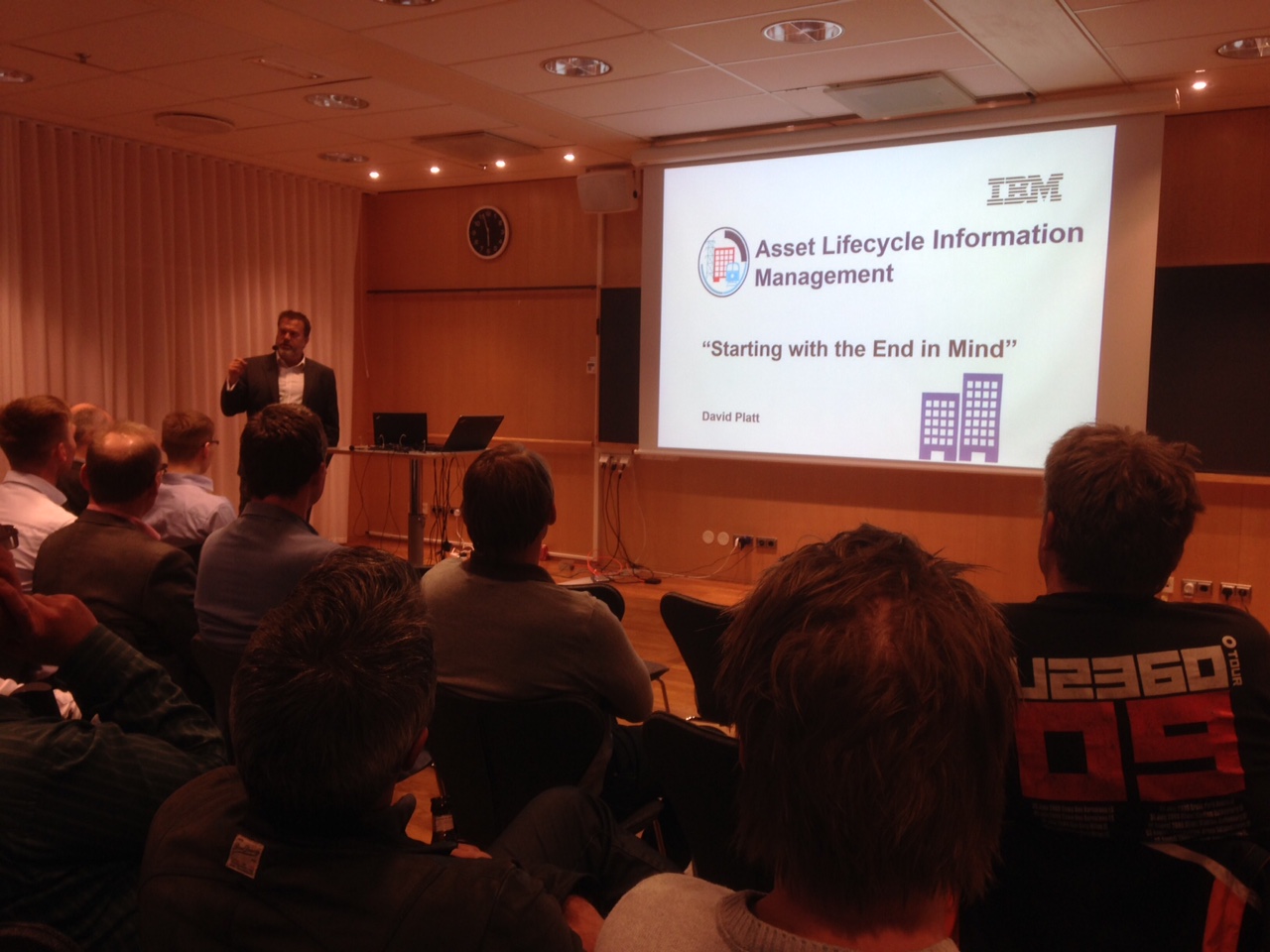
David Platt, industrial products lead at Digital Operations notified the surge in the number of organizations that see data as a resource. This is, in turn, triggered by the need for more lean performances as a business advantage over competent global competitors. Buildings are no more seen merely as buildings rather as dynamic material banks that should be used and re-used by building-owners efficiently. The key to a more functionally and environmentally efficient use and re-use of buildings and their embodied assets is constant measurement of building performance and tracing of building materials and assets. The seamless flow of information that is required for realizing this vision calls for soft-landing periods through handover of facilities and a shift of mentalities from silo thinking to collaborative thinking.

The moment technologies and working processes for a coordinated and steady flow and provision of building information are in place, predictive analyses for optimizing setups of assets and accurate KPI management in FM companies would be plausible.

¤¤¤¤¤¤

The final report of this post is about the intense and informative lecture by Jesse M. Keenan, adjunct professor at Columbia University and the director of the Center for Urban Real Estate (CURE). It was titled as "Recent Research in the Adaptation of the Built Environment" and held on 9th April at the Department of Urban Planning and Environment of KTH.

In an earlier post, I had reported on an earlier seminar focused on strategies for coastal resilience.  During that event, Hurricane Sandy was repeatedly referred to as one of the motivations and stimuli for aligning greater efforts for promoting resilience in urban and regional design and planning.

Hurricane Sandy was again mentioned by Keenan through his talk. Though, his remedy for hazards as such was a set of methodologies and concepts termed as 'adaptation' this time. According to the principals of adaptation as articulated by Keenan, natural hazards such as hurricanes, floods and tsunamis affect our built environment in such an extensive and devastating scale and in such diversified ways that confronting them urges for an overall shift in planning paradigms. While more focused solutions pronounced as the concept of 'resilience' mainly focus on maintaining the status quo though spatial provisions, adaptation is about handling massive transformations that could not be reversed. Adaptation is conceptualized at a more strategic level also incorporating top-level social and economic aspects of spatial decisions prior and during disasters. IT-features are essential for and central to adaption strategies.

A subtle point raised in Keenan's speech was the inherent conflict between adaptation and sustainability: sustainability in one system results in instability of other systems, while adaptation deals with the entire equilibrium as a whole. All in all, the concept of 'adaptation' suggests alluring prospects for confronting severe natural hazards of large magnitudes. Such holistic strategies for shaping and managing built environment should be constantly applied over long periods if the capacity for confronting destructive hazards is truly to be created ad maintained. A requisite for this is powerful and stable central decision-making institutions with legitimized top-down mandates. In the absence of such arrangements, more limited but focused and concrete solutions devised at the level of individual structures and urban level sound more plausible and beneficial.

Sunday, August 17, 2014

BIM-Forum


The concluding talk by Prof. Thomas Kalbro
Department of Real Estatae and Construction Management of KTH had its two-day kick-off gathering after the summer on Thursday and Friday last week. The sessions were composed of reports and group discussions on the two main themes of research and education as well as current and expected performance of the department and emerging fields in research and education. The venue was Djurönäset which is located in the far west of Stockholm's archipelago and almost at the verge of Baltic Sea. This was a timely opportunity for exchange of experience and knowledge in a relaxed environment, socializing with others at the department and breeding grounds for more collaboration and synergy in the coming year.

Division wise meeting of Project Communication; right to left:
Hannes Lindblad, Tina Karrbom Gustavsson and Prof. Väino Tarandi
The main motivation for this post is, however, presenting a delayed report on BIM-Forum organized by Cad-Q last May. The event was a thorough complement to an earlier seminar by Cad-Q elaborating on BIM 360 Glue and BIM 360 Field. The seminar was opened by a role play that simulated the building information flow through a complete reconstruction/addition process from the initial requirements management phase to operation. Participants in the demonstration represented different roles in a reconstruction/addition project e.g. the owner and the architect.

The role play simulating the building information flow
through a complete reconstruction/addition process
The point of departure was submitting a request by the owner for access to the drawings of the site and the existing facilities on the site. Currently, drawings are mostly in DWG or raster formats and deposited in digital archives of the FM firms such as HyperDocInteraxo (previously projektnavet) is Cad-Q's new web-based solution for archiving building drawings and models in more intelligent formats; while another product, BIMeye, serves as a requirements repository. BIMeye is composed of a variety of modules such as Door Manager, Room Manager, Audit Trail, etc. A useful functionality in this application - which is also available in other requirements management software such as dRofus - is creation and re-use of semi-standard room types. Customization of existing room types, classification of requirements according to different disciplines and export to popular formats such as Excel are some other functionalities of BIMeye.

The architect then opens the model in his/her BIM authoring software, in this example Revit, and uses the mass-modelling tool to create room objects based on the requirements imported from BIMeye. The newly planned or modified parts and elements of the building are modelled within Revit and exported as IFC through Naviate functionalities. Room objects and other essential parts could, in turn, be imported to MEP applications. Further disciplinary requirements such as heat transfer, glow and light intensity are then imported from BIMeye and added to corresponding building elements. Components are modified when required so as to fulfill the new requirements. The outcome is channeled back to other actors as the base for further development and the design is incrementally formed by all disciplinary actors in an iterative manner.

The BIM coordinator deploys Navite to guarantee that correct information is included in the exported IFC models. Simplebim - which operates in the background of Naviate - also controls for compliance with a host of measures such as availability of required information for energy, ingress and igress analysis, accessibility and other Swedish building codes. Similar to Solibri Model Checker, the results could be reported in a multitude of formats such as PDF, PPT and BCF (BIM Collaboration Format). The BCF file is then sent to relevant actors via email, project's repository or Naviate BCF Manager. New BCF files could be consecutively created and shared.

When the design is finalised, detailed information on new rooms such as wall and floor finishes are registered by BIMeye in the form of searchable Room Data Sheets (RDS) including intelligent fields for different parameters. BIMeye also enables synchronising RDS's with the BIM model and querying the database based on desired values for specific parameters.

In the second session, I participated in the facility management track due to my research interests. The three other tracks were for architects, structural engineers and MEP engineers. Anne Ellingbö provided a brief introduction on Interaxio and its functionalities namely archiving drawings, revision management and administrating the approval procedure. This file repository is in principle comprised of a folder structure. A specific type of folder, called "smart folder", provides some advanced possibilities such as facilitated grouping of files, batch property assignment to files, export to Excel sheets, etc.

The next speaker was Anders Moberg, manager of CAD Quality AB. He briefly presented the latest advances in implementation of BIM for facility management and the state-of-the-art of deploying new tools and technologies for propelling the sector through the consecutive stages of BIM-maturity. Moberg mentioned a number of initiatives throughout Sweden for converting legacy drawings of existing buildings to object-based models and complementing them with techniques such as laser scanning. Projects by Region Skåne, Locum, Fortifikationsverket, Riksdagsförvaltningen and Falu Kommun were among the examples mentioned by Moberg.

The final presentation was an introduction of the new version of HyperDoc. Security measures for acess of different groups of users, versioning at the object and field level, customized views to the central object-based model and the possibility for importing IFC and fi2 files were some of the new features introduced. Even though the FM&O sector has traditionally been lagging behind other actors in the building industry in embracing new information technologies, recent political ambitions and technological advances demonstrate signs of accelerating the progress in the field. Lack of universal standards and mismatch among current FM&O workflow procedures and the ones required for a BIM-based practice are two main obstacles on the way to be tackled.

Tuesday, February 26, 2013

Who earns from BIM?


On Friday, 15th February, people from different firms and disciplines within Swedish building industry gathered at Clarion Hotel in Stockholm to hear more about BIM (Building Information Modeling), this time with a focus on the financial gains of the technology. The seminar was jointly organized by WSB consulting company and Byggindustri magazine. Here comes an elective summary:

The session was initiated by Mats Lindgren's report on the actual situation of implementation of BIM around the world: Adoption of BIM in the United States is, in brief, broad but not mature enough. In Scandinavia, Finland, Norway, and the Netherlands are more advanced. Mandating BIM deliverables for public projects is planed to be enforced by 2016 in the UK. South Korea, Singapore, and Hong Kong are the pioneers among the east Asian countries, while there is no accurate evaluation of the situation in China. Australia and New Zealand are fairly progressive, while AEC firms in the Middle East, India, and Africa have stepped in, but with a slow pace in comparison.

Facility managers, who where not that interested in BIM technologies in 2009, are now more avid according to studies on perceived usefulness of BIM across actors and disciplines. PEAB has a considerable rate of BIM implementation in the design phase, but their construction sector yet largely relies on previous work flow configurations.

Ewa Hedberg presented an interesting report on results of surveys on the perception of BIM by Swedish AEC/FM companies. Attitudes span over a wide variety of standpoints and strategies from a total indifference, through implementation but no engagement at managerial levels, to some type of strategic agenda with no actual manifestation. An amazing conclusion was that a great number of actors believe that this is the owners and facility operators who can get the most out of BIM. There will thus be no incentive for design and construction crew in providing elaborate BIM's, if the eventual end-users are not willing to pay for their efforts.

Some positive views around BIM are as followed: problems are more easily discovered during the design phase rather than construction using BIM; BIM is definitely a time-saving tool; BIM tools are modern and cool! BIM helps attracting smart people to firms. Fewer errors, higher quality, and efficient use of resources are undoubted gains in the construction phase. According to Rikard Espling from Skanska, the profits gained by BIM are measured according to effective material use, reduction of accidents, quick preparation of quantity take-offs, and discovery of mistakes from design.

Perceived obstacles, on the other hand, are: organizational problems, staff engagement, and lack of expertise; many prefer to continue with prevailing traditional routines that they are accustomed to; specially the older generation find BIM only an unnecessary pushing force with no considerable positive effect; small firms can not afford rather high expenditures of establishing BIM systems; there are numerous uncertainties on what exactly BIM is, how exactly it should be implemented, what types of information it requires and from which resources should such data be obtained, and is it only confined to new construction?

Despite a unanimous positive view of all actors, not sufficient thorough studies have yet been conducted on indicators for usefulness of BIM in facility management. People are often bewildered about how to translate visions into concrete outcomes and scale down the concepts to tangible daily applications. Nonetheless, some advantages are now being more clearly pronounced and comprehended: enhanced computerized problem reporting, quickly articulating optimal solutions, fast and accurate area calculation for commissioning and ordering commitments, provision of detailed information for operational decision making, etc.

The event was concluded with a intriguing panel discussion among Staffan Åkerlund (Byggindustrin), Malin Lösjögård (Svensk Betong), Anne-Therese Albertsson (Trafikverket), Rikard Espling (Skanska), and Pontus Bengtsson (WSP). One of the audience suggested a thoughtful explanation on why the building industry is always lagging behind others in application of new information technologies such as BIM: what is missing here is the global market pressure and competition that other disciplines such as car industry are constantly exposed to.

The uncomfortable truth, at the end of the day, is that almost a decade after advent of Building Information Modeling tools, there is still need for introductory clarifications for the industry. Moreover, as almost all speakers declared, there are not fully established methodologies for quantifying the gains brought about by BIM. Participants mentioned however some approximate figures ranging from one to 15 percent as the ROI incurred by implementation of BIM. One aperture of hope is that more light has recently been shed on the importance and profitability of BIM for facility owners and managers, meaning that a higher demand from the real end-customers of building information models could be conceived and expected in the near future. This means stronger motives for the authors of BIM content and shiny prospects for an efficient, informed, and collaborative equilibrium for building industry.