Showing posts with label Building Information Management. Show all posts

Wednesday, September 21, 2016

ECPPM 2016

The 11th European Conference on Product and Process Modelling (ECPPM) was held Limassol, Cyprus, 7th to 9th September. Use of the acronym BIM (Building Information Modelling) was noticeably much more widespread compared with previous conferences in Vienna and Reykjavik. The trend was also addressed by Dr. Raimar Scherer in his opening speech connoting that - despite all ambiguities and misinterpretations - the concept of BIM is now central to the domain of building information management and broadly used by both academicians and practitioners. He also highlighted the increasing importance of interlinking existing semantic data and developing more efficient stochastic methods for analyzing the massive sets of data known as big data.

Dr. Lucio Soibelman from University of Southern California was the first keynote speaker. He raised a broad range of issues from implementing BIM for a more lean construction industry to new classification, query and analysis methods for efficient use of sensor data. One of the presented classification methods was identifying signatures of materials through photos of buildings and spaces with the aim of batch-tagging of photos. In the same way, visual signatures of different activities could also be identified using data sourced from sensors. As an example, the peak times of electricity consumption in an office could be associated with certain behaviors of the employees. This is done by identification of the visual signature of those behaviors through real-time data graphs. The real problem, however, is how to apply such insights for promoting a more efficient use of reaources. Empirical evidences show that changing the behavioral patterns of the employees proves to be an even greater challenge the moment the counter-productive behaviors have been identified.

Another fascinating initiative presented by Dr. Soibelman was a method for identifying defects of urban water distribution systems through analysis of videos captured by small robots running through pipes. Such an approach could result in considerable cost savings through replacing costly reactive maintenance tasks by less expensive predictive maintenance measures informed and triggered by updated visual information. The process of analysis of the captured videos is, however, not entirely automated yet. Spatial analysis of the collected data from the piping network will also facilitate identification of break clusters which could be used for analyses at macro level.

The keynote speaker of the second day, Dr. Rafael Sacks
The keynote speaker of the second day of the conference was Dr. Rafael Sacks, the co-author of BIM Handbook. The focus of his presentation was on how to automate the process of intelligence semantic enrichment of existing BIMs for specific use cases. Such processes are nowadays to a great degree manual and thus tedious and error-prone. His radical suggested fix was to replace Model View Definitions (MVDs) with a set of semantic rules within the original native BIMs. In this approach, building components are directly distinguished by those rules rather than by the MVD-specific IFC exporters of the proprietary BIM-authoring applications. Such an approach could resolve some of the currently prevailing problems with IFC exports such as individual pieces of slabs being aggregated to one component or incorrect semantic definitions of translated components (e.g. windows exported as doors or studs exported as columns or beams). A relationship feature matrix embracing topological features such as adjacency and containedness lies at the heart of this proposal. The presentation was concluded with introducing the optimistic vision of performing a BIM round trip where no information is lost or distorted.

The opening lecture of the third day by Dr. Ioannis Brilakis from Cambridge University elaborated on the challenges around creating as-is BIMs. Mid-range mobile videogrammetry and videotaping were two suggested methods for this purpose. The models produced by videotaping could be directly sent to CNC machines for the purpose of maintenance of existing structures such as roofs and road surfaces. The input data could be sourced from readily available devices such as the parking cameras of cars. Processing of the scanned models of more complicated structures is, however, more demanding. The point-cloud model of a middle-sized building captured in one single day, for example, may require up to ten working days of alteration and semantic enrichment.

The suggested fix for this problem presented by Dr. Brilakis was a top-down recursive enrichment methodology where major elements of the structure are distinguished first and further details are then identified incrementally. Such an approach would be most appropriate for simpler structures with fewer and well-distinguished components such a s bridges. Applying this method to more complicated structures such as buildings and factories requires more elaborated techniques. Next-level challenges would be how to capture non-visible information i.e. the internal structure of building elements. A relevant concern raised by the third keynote speaker was how sensor data should be integrated with the building models procured in conventional formats. The unanswered questions that were brought up by the speaker were whether new data model extensions should be added to the IFC schema for capturing sensor data; whether sensor values should be registered as properties of the building component in the model; and whether a new concept of "live BIM" needs to be defined.

Semantic web or a web of building information was a recurring topic through presentations. The motivation behind the semantic web initiatives is, in a nutshell, to provide a more flexible alternative for capturing building information from different actors across construction industry. The ifcOWL ontology, the RDF data model and Product Data Templates (PDTs) were the most referred features within the semantic web concept.

Indulging in traditional Cypriot meze following visit to
Limassol Castle, the first four persons in front of the photo
 in a CCW direction: Elektra Petrova from Aalborg University,
 me, Eleni Papadonikolaki from TU Delft and  Dr. Eilif Hjeseth
from Oslo and Akershus University College of Applied
Science (Source of the photo)
Several speakers addressed the ambiguities around the acronym LOD (level of detail or level of development). Apparently, the most agreed-upon interpretation of LOD among industry actors is the one adopted by the American Institute of Architects (AIA) for the AIA G202-2013 Building Information Modeling Protocol Form i.e. the levels defined for building models as LOD 100 to LOD 500. A handful of alternative terms have been suggested for more clarity namely level of reliability, level of completeness, level of information and level of approximation. These terms are sometimes associated with other BIM concepts such as BIM data drops and exchange requirements (ERs). A comprehensive review of the history and variations of interpretations of the term LOD could be found here.

Hurdles of information management in the FM sector, methods and metrics for measuring the benefits of BIM and monitoring indoor climate were some other prevalent topics. Standardization of building information communication formats and processes was also a shared concern among participants as it is deemed an essential requirement for a holistic approach to built environment information management. 

Tuesday, June 30, 2015

Miscellaneous thoughts and reports on built environment: from economic segregation to IoT, adaptation and resilience

The lunch seminar on 10th June at our department was devoted to a talk by Dr. Kerstin Annadotter titled as "From centralized housing policy to structural economic discrimination – Analyzing the effect of minimum income criteria and income type restrictions on the Swedish rental housing market". The point of departure was the minimum-salary requirements imposed by housing associations in Sweden.

Access to the rental housing stock in Stockholm and other major Swedish cities is primarily regulated through waiting queues. The waiting time for renting out a residential unit in central Stockholm can take up to a couple of decades. Yet, this is often not the only criteria. Eventually, owners have the ultimate authority to evaluate and approve applicants mainly based on their income. A rule of thumb is that housing expenditures of the prospective tenants should not exceed thirty percent of their incomes. This is though not always the case and the owners' subjective measures in verifying tenants could result in discrimination.

In practice, several rental housing queues have been formed based on a combination of waiting time and the applicants' incomes. Low-income households are therefore constantly denied access to more attractive districts of the city, which aggravates economic segregation. The question that follows is whether income level is an appropriate measure for pre-evaluating applicants. An alternative approach is setting waiting times as the only criteria and providing the owner with the right to expel tenants later in case they are not able to pay the rental.

¤¤¤¤¤¤

On 8th June, Stockholm Association of Architects (Stockholms Arkitektförening) held their spring review of the prominent recent architectural works. The president, Jonas Elding, opened the session. Each speaker or team of speakers shortly presented one or two of their projects.

Bolle Tham och Martin Videgård have established an international reputation for their brick buildings. In the case of the new School of Architecture at KTH which is surrounded by older buildings of dark red bricks, however, they have maintained the harmony through corten steel facade cladding instead.

In an earlier post in this blog, I had shortly written about Fittja People's Palace as presented within the "Architects for Architects" event organized by Graphisoft a while ago. Ola Broms Wessel from Spridd Architects and Madeleine Nobs from NCC presented the project. The main qualities of the project as uttered by the speakers were maximum participation of stakeholders in the design procedure through meetings, talks and workshops, great emphasis on social coordinates of the projects and maintaining high standards within reasonable costs.

Some of the presented projects were on the other side of the spectrum with their main focus on formal innovations and new ways of using materials.
Kalle Dinell and Morten Johansson from DinellJohansson presented their project for auxiliary facilities - including grandstands and cafes - for a football stadium in Lidingö. The designed structure has been erected on an overall hexagonal geometric grid which is manifested in both plan and facade.

Emma Jonsteg from Utopia Architects presented their solution for housing shortage in Stockholm. Their suggestion is to extend the favored concept of sharing spaces - which is nowadays quite popular in designing workplaces - to apartments. An example of dwelling design as such is KomBo. The project is located in Sundbyberg and accommodates large apartments with plenty of bedrooms with own sanitary facilities and shared kitchen and living halls instead of small apartments for singles. The aim is to promote more social and vibrant yet economic ways of living.

Johan Arrhov from Arrhov Frick, Carolina Wikström and Frida Öster from Asante, Louise Robinson from Blå arkitektur landskap, Johanna Nenander from KTH, Åsa Drougge and Göran Lindberg from Nivå landscape architects and Johanna Jarméus from Lovely landscape architects were the other speakers of the event.

¤¤¤¤¤¤

Takaharu Tezuka is a reputed Japanese architect who has worked at Richard Roger's office for a while and developed a number of prestigious designs. On 1st June, he presented a selection of his works varying largely in type and size, from private residences to primary schools. He constantly questions the status quo and challenges the given program and national and regional codes and regulations in search of new qualities and values in architecture. The event had been jointly organized by Stockholm Association of Architects and KTH School of Architecture and was held in F3 lecture hall at KTH main campus.

¤¤¤¤¤¤

On 6th May, I defended my licentiate thesis during a challenging, intriguing and inspiring discussion with the opponent, Dr. Stefan Olander, associate professor at University of Lund and national coordinator at the Swedish Universities of the Built Environment (SBU). The seminar session was followed by a brief celebration and mingle at our department. The thesis work consisted four peer-reviewed conference papers (below) preceded by an introductory section that motivated the papers and mapped them onto the overall landscape of my research:
The time for chilling out, creamy cakes and drinks for recovering from lengthy months of intellectual endeavors, hammering out the text and arranging all practicalities and formalities of the licentiate degree was though soon over. The second round of my research has just been initiated with preparatory studies, refining drafted plans and making necessary contacts for building up an extensive multiple-case study setup. The work will be continued over a period of app. two years in parallel with other administrative and teaching responsibilities such as running the master-level course, 'Project Development and Architectural Concepts'.

¤¤¤¤¤¤

On 28th April, BIM lounge 2015 was held at the headquarters of Tyréns consulting firm in Stockholm where speakers from Sweden and U.K. shared their insights and experiences about the synergic effects envisioned by merging BIM as a Service (BaaS) and Internet of Things (IoT). Unfortunately, I missed the final presentations on the ubiquitous facility management system, IBM Maximo and the demonstration on the integrated use of IoT and BIM.

Ulrika Franke, CEO of Tyréns and president of BIM Alliance Sweden was the first speaker. She referred to the conservative nature of building industry and how this restrains efficiency and aggravates waste of resources. She then postulated that digitalizing is the central clue to improve automation in construction. This requires educating all actors across the AECO industry, new regulations and advanced business models, according to her.

Anders Fredholm, vice president of IBM Global Business Services clarified their initiative for encouraging a more efficient building information management. IBM promotes the notion of 'BIM as a service' (BaaS) implying that BIM is now an industry driver across the entire lifecycle of buildings from inception, through operation and maintenance and towards recycling and re-use of building materials. Fast and on-the-fly access to building information is increasingly becoming a business-enabler for construction firms. New contractual methods are gaining grounds for facilitating usecase-based payments. While actors in the automotive industry have now widely adopted Product Lifecycle Management (PLM) methods and Digital Mock-ups (DMUs) are prevalent in design of aircrafts and ships, the AECO industry is still lagging behind. Together with other public and private agents and within national programs such as RIBA Plan of Work in the UK, IBM aims to encourage actors to develop their skills and go digital.

The AECO industry is lagging behind others when it comes to automation (diagram is taken from my licentiate thesis
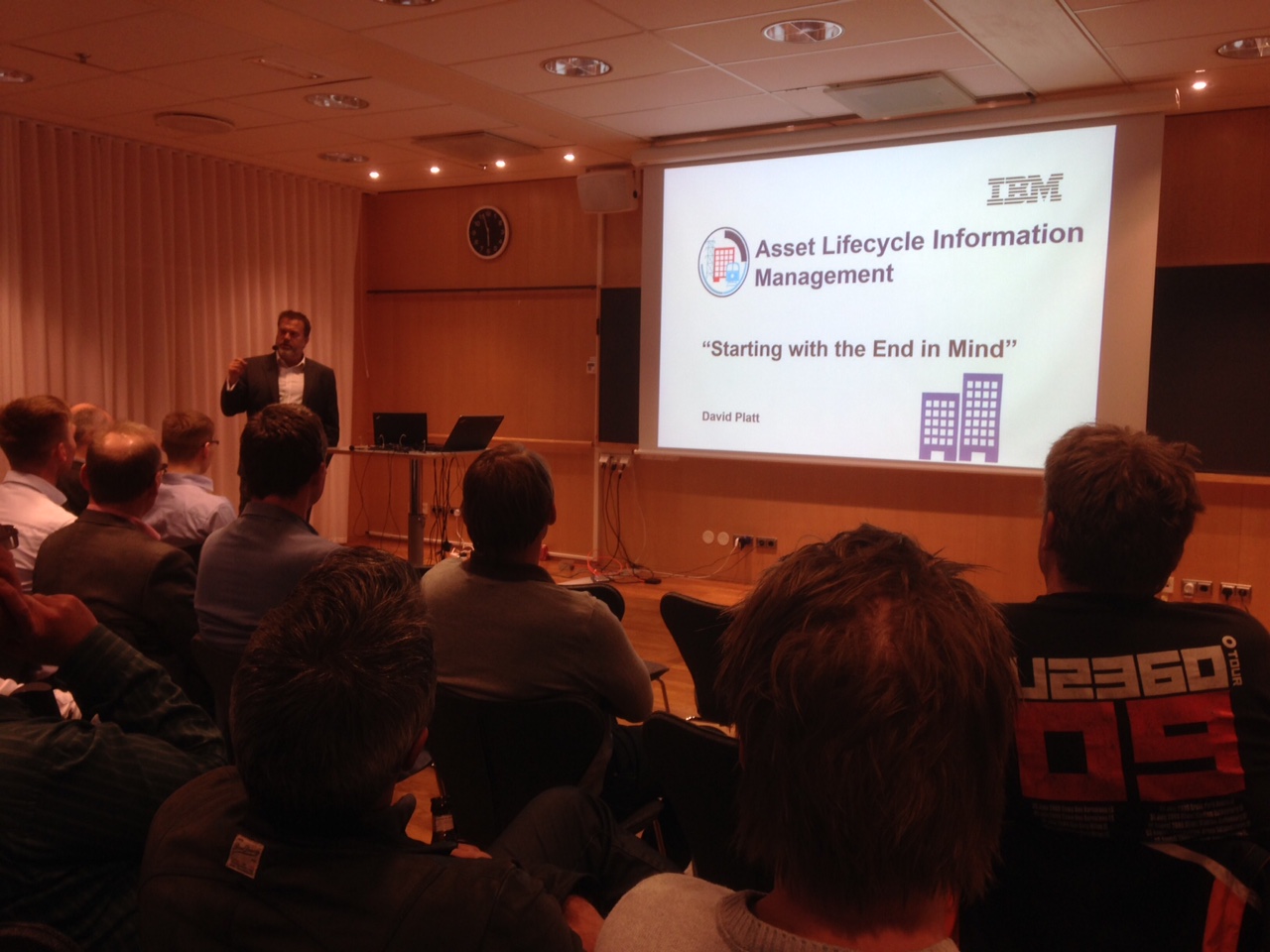
David Platt, industrial products lead at Digital Operations notified the surge in the number of organizations that see data as a resource. This is, in turn, triggered by the need for more lean performances as a business advantage over competent global competitors. Buildings are no more seen merely as buildings rather as dynamic material banks that should be used and re-used by building-owners efficiently. The key to a more functionally and environmentally efficient use and re-use of buildings and their embodied assets is constant measurement of building performance and tracing of building materials and assets. The seamless flow of information that is required for realizing this vision calls for soft-landing periods through handover of facilities and a shift of mentalities from silo thinking to collaborative thinking.

The moment technologies and working processes for a coordinated and steady flow and provision of building information are in place, predictive analyses for optimizing setups of assets and accurate KPI management in FM companies would be plausible.

¤¤¤¤¤¤

The final report of this post is about the intense and informative lecture by Jesse M. Keenan, adjunct professor at Columbia University and the director of the Center for Urban Real Estate (CURE). It was titled as "Recent Research in the Adaptation of the Built Environment" and held on 9th April at the Department of Urban Planning and Environment of KTH.

In an earlier post, I had reported on an earlier seminar focused on strategies for coastal resilience.  During that event, Hurricane Sandy was repeatedly referred to as one of the motivations and stimuli for aligning greater efforts for promoting resilience in urban and regional design and planning.

Hurricane Sandy was again mentioned by Keenan through his talk. Though, his remedy for hazards as such was a set of methodologies and concepts termed as 'adaptation' this time. According to the principals of adaptation as articulated by Keenan, natural hazards such as hurricanes, floods and tsunamis affect our built environment in such an extensive and devastating scale and in such diversified ways that confronting them urges for an overall shift in planning paradigms. While more focused solutions pronounced as the concept of 'resilience' mainly focus on maintaining the status quo though spatial provisions, adaptation is about handling massive transformations that could not be reversed. Adaptation is conceptualized at a more strategic level also incorporating top-level social and economic aspects of spatial decisions prior and during disasters. IT-features are essential for and central to adaption strategies.

A subtle point raised in Keenan's speech was the inherent conflict between adaptation and sustainability: sustainability in one system results in instability of other systems, while adaptation deals with the entire equilibrium as a whole. All in all, the concept of 'adaptation' suggests alluring prospects for confronting severe natural hazards of large magnitudes. Such holistic strategies for shaping and managing built environment should be constantly applied over long periods if the capacity for confronting destructive hazards is truly to be created ad maintained. A requisite for this is powerful and stable central decision-making institutions with legitimized top-down mandates. In the absence of such arrangements, more limited but focused and concrete solutions devised at the level of individual structures and urban level sound more plausible and beneficial.

Sunday, August 17, 2014

BIM-Forum


The concluding talk by Prof. Thomas Kalbro
Department of Real Estatae and Construction Management of KTH had its two-day kick-off gathering after the summer on Thursday and Friday last week. The sessions were composed of reports and group discussions on the two main themes of research and education as well as current and expected performance of the department and emerging fields in research and education. The venue was Djurönäset which is located in the far west of Stockholm's archipelago and almost at the verge of Baltic Sea. This was a timely opportunity for exchange of experience and knowledge in a relaxed environment, socializing with others at the department and breeding grounds for more collaboration and synergy in the coming year.

Division wise meeting of Project Communication; right to left:
Hannes Lindblad, Tina Karrbom Gustavsson and Prof. Väino Tarandi
The main motivation for this post is, however, presenting a delayed report on BIM-Forum organized by Cad-Q last May. The event was a thorough complement to an earlier seminar by Cad-Q elaborating on BIM 360 Glue and BIM 360 Field. The seminar was opened by a role play that simulated the building information flow through a complete reconstruction/addition process from the initial requirements management phase to operation. Participants in the demonstration represented different roles in a reconstruction/addition project e.g. the owner and the architect.

The role play simulating the building information flow
through a complete reconstruction/addition process
The point of departure was submitting a request by the owner for access to the drawings of the site and the existing facilities on the site. Currently, drawings are mostly in DWG or raster formats and deposited in digital archives of the FM firms such as HyperDocInteraxo (previously projektnavet) is Cad-Q's new web-based solution for archiving building drawings and models in more intelligent formats; while another product, BIMeye, serves as a requirements repository. BIMeye is composed of a variety of modules such as Door Manager, Room Manager, Audit Trail, etc. A useful functionality in this application - which is also available in other requirements management software such as dRofus - is creation and re-use of semi-standard room types. Customization of existing room types, classification of requirements according to different disciplines and export to popular formats such as Excel are some other functionalities of BIMeye.

The architect then opens the model in his/her BIM authoring software, in this example Revit, and uses the mass-modelling tool to create room objects based on the requirements imported from BIMeye. The newly planned or modified parts and elements of the building are modelled within Revit and exported as IFC through Naviate functionalities. Room objects and other essential parts could, in turn, be imported to MEP applications. Further disciplinary requirements such as heat transfer, glow and light intensity are then imported from BIMeye and added to corresponding building elements. Components are modified when required so as to fulfill the new requirements. The outcome is channeled back to other actors as the base for further development and the design is incrementally formed by all disciplinary actors in an iterative manner.

The BIM coordinator deploys Navite to guarantee that correct information is included in the exported IFC models. Simplebim - which operates in the background of Naviate - also controls for compliance with a host of measures such as availability of required information for energy, ingress and igress analysis, accessibility and other Swedish building codes. Similar to Solibri Model Checker, the results could be reported in a multitude of formats such as PDF, PPT and BCF (BIM Collaboration Format). The BCF file is then sent to relevant actors via email, project's repository or Naviate BCF Manager. New BCF files could be consecutively created and shared.

When the design is finalised, detailed information on new rooms such as wall and floor finishes are registered by BIMeye in the form of searchable Room Data Sheets (RDS) including intelligent fields for different parameters. BIMeye also enables synchronising RDS's with the BIM model and querying the database based on desired values for specific parameters.

In the second session, I participated in the facility management track due to my research interests. The three other tracks were for architects, structural engineers and MEP engineers. Anne Ellingbö provided a brief introduction on Interaxio and its functionalities namely archiving drawings, revision management and administrating the approval procedure. This file repository is in principle comprised of a folder structure. A specific type of folder, called "smart folder", provides some advanced possibilities such as facilitated grouping of files, batch property assignment to files, export to Excel sheets, etc.

The next speaker was Anders Moberg, manager of CAD Quality AB. He briefly presented the latest advances in implementation of BIM for facility management and the state-of-the-art of deploying new tools and technologies for propelling the sector through the consecutive stages of BIM-maturity. Moberg mentioned a number of initiatives throughout Sweden for converting legacy drawings of existing buildings to object-based models and complementing them with techniques such as laser scanning. Projects by Region Skåne, Locum, Fortifikationsverket, Riksdagsförvaltningen and Falu Kommun were among the examples mentioned by Moberg.

The final presentation was an introduction of the new version of HyperDoc. Security measures for acess of different groups of users, versioning at the object and field level, customized views to the central object-based model and the possibility for importing IFC and fi2 files were some of the new features introduced. Even though the FM&O sector has traditionally been lagging behind other actors in the building industry in embracing new information technologies, recent political ambitions and technological advances demonstrate signs of accelerating the progress in the field. Lack of universal standards and mismatch among current FM&O workflow procedures and the ones required for a BIM-based practice are two main obstacles on the way to be tackled.

Monday, March 24, 2014

Miscellaneous Diary

Time flies and my posts become more sporadic. Having some hours to spend at Helsinki Airport on my way back from a short trip to Budapest, it is perhaps the right time for writing a summarized retrospective diary comprising the highlights since I wrote about Stockholm Student Fair:


On 7th February, I made a visit to the conceptual exhibition, Light Houses, at the Museum of Architecture in Stockholm. Thirty two young architectural firms from Sweden, Norway and Finland presented their ideologies and methodologies through "objects" and "words". Works were ranging from utterly abstract and conceptual ones to building models and even a book of technical drawings. My favorites were the works by the Finnish firm, Lundén Wikar Österlund and the Mirror Cube by the Swedish firm, Tham & Videgård.

In the afternoon of the 9th February, I joined the introduction ceremony for foreign students in Sweden held at the City Hall. The event was opened by Margareta Björk, the chair of Stockholm Municipality. Then, it was time for talks by the head of education, the CEO of Stockholm Business Region Development, director of Staf (Maria Fogelström) and the vice president of SSCO (the central student union organization in Stockholm). Maria left a 2-minute portion of Staf's time to me for introducing our NGO, SIRAP, and its activities.

This is now a while that I have been participating in information management meetings of a construction project for building an educational facility in the campus which is located just a hundred meters from my office. This exquisite building is designed by the Danish architectural firm, Cco, and is a unique project from different aspects: the building itself is a study object by making parts of its structural, mechanical and electrical components visible to the users; it accommodates flexible education and exhibition spaces with an interior layout that allows quick shift between different education modes. The building will be ready for use by 2016.

Something even more important about this project for us at the Division for Project Communication is that we will be able to use all digital models of the building for educational and research activities. In order to get updated about information management and digital modelling status of the project, I will be participating in two categories of the meetings: BIM-coordination sessions and BIM-development session. On 11th February, the very first occasions of the two meetings were held, BIM-representatives of all participating firms as well as the participants from KTH research group were introduced to eachother, and the overall principles of information management for the project were announced by the BIM-consultant firm, Plan B. In the following BIM-coordination meetings on 25th February and 11th March, more details about modelling routines, information sharing and exchange formats were discussed.

Lunch seminars are part of a share-and-discussion tradition at the Department for Real Estate and Construction Management. On 12th February, Prof. Hans Lind presented his new book together with Prof. Thomas Kalbro and Prof. Göran Cars, "New regulations for increased residential construction and better infrastructure". The book is mainly a critical overview of prevailing planning autonomy of municipalities in Sweden which, in the absence of efficient and sufficient motivations and incentives, has resulted in an increasing gap between the supply and demand of residential buildings is Sweden. Authors also propose new legislative approaches with a stronger role for both the central government (forcing municipalities to plan) and also a stronger role for the developers when it concerns the details of the plans and buildings as a remedy for this problem.

14th February, I had an stimulating conversation with Sara Eriksson, planner at KTH, as part of an ongoing study on requirement management. It was amazing to hear about the way the client (here Akademiska Hus) and the prospective tenant (KTH) collaborate in jointly providing the consultants with descriptions, criteria and measures of the building they will operate and use.

During the previous session of a series of discussions on qualitative methods at our department, I shared my recent experiences from a paper submission with others on 17th February. First, I went through different sections of my work (now submitted to CIB W070, W111 & W11 in Copenhagen) and asked the audience about their opinions on the overall layout and structure of the paper. Then, we discussed the comments I had received from the reviewers and how things could be enhanced prior to the final submission.

My afterwork session in the evening of the 28th February was a talk on intercultural communication and Swedish culture organized by us at SIRAP and given by Karin Knutsson. The talk was followed by a broad contribution and challenging questions from the audience mostly trying to better comprehend complicated social codes and norms of the Swedish society.

On 28th February, after months of correspondence and constructive discussions with the co-author, Johannes Dimyadi, I finally submitted the final version of our paper to the CIB conference for facility management. Our work is an analytic description of a progressive example of implementation of BIM-based applications for administering FM&O activities. The project was executed in Auckland (new Zealand) for a campus area. Johannes is the system architect of the BIM-FM solution.

On Sunday 2nd March, I watched "Wolf of Wall Street" which I did honestly not find as splendid as I had heard it to be. There is no doubt that the acts were great and the extravagant and flashy scenes were compelling; but it was really difficult to believe that the movie served in the first place an edifying purpose and was actually not a glorification and celebration of power, wealth and American life as common to the mainstream of cinema in the US.

On 4th and 5th March, our department hosted a Ph.D. workshop with participants (both Ph.D. students and supervisors) from the Swedish universities of Chalmers, Lund and Luleå. Discussions on theories, methodologies and research structure raised during the workshop were greatly instructive and informative.

From 12th to 14th March, I attended an intensive training course on "Enhanced Personal Leadership & Effectiveness" in Norrtälje (North of Stockholm). Other than useful lectures and experiments on presentation skills, advocacy and enquiry techniques, inter-cultural communication, etc. the course was a timely opportunity for self-reflection and self-evaluation. The course was organized by departments of transport and computer science of KTH.

During the last week, a lot happened here in Stockholm in the subject area of standardization of information modelling and management of the built environment. The plenary sessions of the buildingSMART week were held at Stockholm City Conference Center and KTH main campus 17th to 19th March bringing together the world's highest-level experts from academia, industry and national and international organizations. The main conference session was held on 20th March. This was in fact the very first international presence of the newly-born BIM Alliance Sweden. I will hopefully write more about this event in a separate post soon.


Sunday, August 18, 2013

BIM Alliance Sweden

1.

I have just come back from this year's jubilant education and research seminar of the KTH Department of Real Estate and Construction Management in a spectacular venue in Skåvsjöholm. All the staff including researchers and doctoral students embraced this timely opportunity to get to know each other and exchange their experiences in a relaxed atmosphere with lots of fun and sweets. I too managed to give my first short speech in Swedish for colleagues at the department and swim in the chilly though refreshing waters of the Baltic Sea perhaps for the very last time this year.

2.
Kalle, Alex, me, and Mount Kebnekaise

Two weeks ago, I managed to step on the highest peak in Sweden, Mount Kebnekaise. It took us 16 hours on the railroad to arrive at the country's northernmost city, Kiruna. One more extra hour was needed for the bus trip from Kiruna train station to the furthest place that could be reached by car, Nikkaluokta. Our three-member team then went through the hiking route and settled in the base camp (Fjällstation) after seven hours. Finally, we did the last part the day after and made it to the peak through the West route (Västraleden) in a relaxed 14-hour-long pace.


Despite all rain and drizzle of the first day, we were more than lucky to enjoy a fully sunny day and moderate temperatures during our ascending and descending. Our trip was rounded up by an informative tour to the LKAB's largest underground iron mines around the globe and a short visit to the exquisite church of Kiruna. This is one of the few buildings od the city that will be preserved and intactly transferred to a new location during dislocation of the city center for further excavation operations.

3.

The long Swedish summer vacation period is now almost over and I am finally putting together my notes from the annual OpenBIM conference that was held in Arlanda Airport on 22nd April 2013. The central theme for this round of the conference was the clinents' and practitioners' requirements on BIM. 

Prior to presenting a brief history of evolution of building information modelling (BIM), the first speaker of the day, Professor Arto Kiviniemi from University of Salford paid tribute to Professor Chuck Eastman as the father of the BIM who introduced the basics of the concept as early as the year 1957. He then blamed the conservative mindset of the practitioners in the building industry for their resistance to change which has largely hampered a widespread implementation of BIM after all these years. Yet, the ever-increasing passion of such sizable real-estate and facility management firms as the U.S. General Services Administration (GSA), Senate Properties in Finland, and Statsbygg in Norway envisions a bright future for the building industry as a whole.

Arto addressed a remarkable fact that was also echoed in several keynote talks at the CIB conference in Brisbane a month later: the relatively ample level of technological proficiency in BIM at the time and the more urgent need for handling social and organizational bottlenecks of the technology. This issue was also raised by the second speaker of the day, Dr. Calvin Kam from Stanford University when he addressed the inevitably intertwined applications of sociology and technology. 


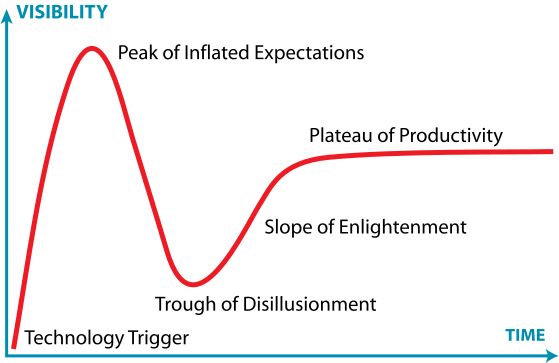
BIM technology now experiences the Plateau of Productivity phase of its Gartner Hyper Cycle according to Arto. More than 150'000 companies and 3'000'000 people around the world are using BIM. The major problem is, however, the uneven implementation of BIM across sectors, life cycle stages, and actors. This has, in turn, led to dramatically diverse maturity levels across different individuals, organizations, and projects. 


In order to realize the full business value of BIM in practice, there is a need for widespread implementation of such novel initiatives as new procurement and insurance models. Large-scale initiatives such as COBIM in Finland, BIM Task Group in the UK, and IPD method (Integrated Project Delivery) in the US will help drive the industry in this direction. Talking about BIM for FM, it is crucial to understand that only what information that is truly needed (mainly consisting of non-graphical information) should be transferred to the FM sector. Arto's speech was followed by a panel discussion among him and representatives from Coor, Tyréns, Skanska, and the Swedish Transport Administration (Trafikverket):
  • Per Bjälness from Coor Service Management emphasized the urge for more user-centric cyber services and provision of structured and measurable information for users of buildings. He also clarified some of the requirements for the BIM material to be delivered to the user such as a clear structure, relevance, and accuracy.
  • Tomas Alsmarker from Tyréns criticized the project-based mindsets in the building industry that hampers a user-oriented integrated approach to building as a product.
  • Rikard Espling from Skanska noticed the importance of early involvement of actors from different disciplines.
  • Arto mentioned the importance of an integrated approach to modelling different components of the built environment including buildings, infrastructure, and industrial plants. He also referred to the significant role of quality assurance processes of information in sieving suitable and reliable information.
  • Mikael Malmkvist from Trafikverket addressed, among all, the necessity of implementing standard solutions and shifting towards web-based knowledge centers for building operation.
Dr. Calvin Kam's speech covered a variety of topics including more efficient model-checking approaches, schema extensibility in building data modelling, the importance of collaborative open-BIM projects and yet the substantial role of proprietary tools and formats, the annual BIM award of AIA since 2003, and the ever-increasing implementation of BIM in China and Hong Kong.

The first speaker of the afternoon session, Professor Thomas Olofsson from Luleå University of Technology presented a chronological account of building modelling and its applications for visualization, integration, and automation. He demonstrated a development pyramid, starting with Technology at the top, passing through Methodology and Process, and ending up to Organization at the base where - again - the importance of social and organizational aspects of building information modelling was declared.

Rogier Jongeling, technical director at Open BIM, was the next speaker who talked about, among all, model-driven data analysis and the consequent need for integrated models for carrying out such analyses, the new PLM approach to building information management (Product Life Cycle Management), and model-driven visualization and coordination. He summed up his talk with a real-time display of an augmented reality tool implemented by Locum for conjuring up 3D models out of existing 2D drawings.

Anders Moberg (CAD-Q) and Väino Tarandi 
(buildingSMART and KTH)
Lars Lidén from Specialfastigheter presented the joint initiative by five major public Swedish facility owner firms including Akademiska hus, Sveriges Riksdagsförvaltningen, FortifikationsverketStatens Fastighetsverk, and Specialfastigheter for developing a common strategy for asset information management. Energy efficiency in building operations, facilitating knowledge transfer and recruitment of new FM&O staff, tackling the problem of efficient use of existing building stock and implications of an open data format approach for early involvement of the FM representatives were some of areas that were covered in this presentation.

Before the news about the upcoming birth of the BIM Alliance Sweden were announced, Håkan Blom provided an overarching presentation about ongoing and planned research activities around building information modelling as defined by the the Strategic Research and Innovation Agenda for Bygginnovationen. Design visualization and coordination, education, jurisdiction and contracts, optimization of industrial processes, life cycle approach to building information management, facility management and operations, customer engagement, and customer satisfaction were the most significant headlines in Håkan's speech.

Finally, Rikard Espling, Mats Broman, and Väino Tarandi, respectively from Open BIM, Föreningen för förvaltningsinformation (fi2), and buildingSMART stepped on the stage to publicly declare the decision made by their corresponding organizations for merging together and forming the BIM Alliance Sweden that will get a head start on January 2014. BAS envisions a closer collaboration and more coordinated and aligned efforts for standardization which will eventually facilitate an unbroken total-life-cycle flow of information for the Swedish building industry.