Showing posts with label resilience. Show all posts

Tuesday, June 30, 2015

Miscellaneous thoughts and reports on built environment: from economic segregation to IoT, adaptation and resilience

The lunch seminar on 10th June at our department was devoted to a talk by Dr. Kerstin Annadotter titled as "From centralized housing policy to structural economic discrimination – Analyzing the effect of minimum income criteria and income type restrictions on the Swedish rental housing market". The point of departure was the minimum-salary requirements imposed by housing associations in Sweden.

Access to the rental housing stock in Stockholm and other major Swedish cities is primarily regulated through waiting queues. The waiting time for renting out a residential unit in central Stockholm can take up to a couple of decades. Yet, this is often not the only criteria. Eventually, owners have the ultimate authority to evaluate and approve applicants mainly based on their income. A rule of thumb is that housing expenditures of the prospective tenants should not exceed thirty percent of their incomes. This is though not always the case and the owners' subjective measures in verifying tenants could result in discrimination.

In practice, several rental housing queues have been formed based on a combination of waiting time and the applicants' incomes. Low-income households are therefore constantly denied access to more attractive districts of the city, which aggravates economic segregation. The question that follows is whether income level is an appropriate measure for pre-evaluating applicants. An alternative approach is setting waiting times as the only criteria and providing the owner with the right to expel tenants later in case they are not able to pay the rental.

¤¤¤¤¤¤

On 8th June, Stockholm Association of Architects (Stockholms Arkitektförening) held their spring review of the prominent recent architectural works. The president, Jonas Elding, opened the session. Each speaker or team of speakers shortly presented one or two of their projects.

Bolle Tham och Martin Videgård have established an international reputation for their brick buildings. In the case of the new School of Architecture at KTH which is surrounded by older buildings of dark red bricks, however, they have maintained the harmony through corten steel facade cladding instead.

In an earlier post in this blog, I had shortly written about Fittja People's Palace as presented within the "Architects for Architects" event organized by Graphisoft a while ago. Ola Broms Wessel from Spridd Architects and Madeleine Nobs from NCC presented the project. The main qualities of the project as uttered by the speakers were maximum participation of stakeholders in the design procedure through meetings, talks and workshops, great emphasis on social coordinates of the projects and maintaining high standards within reasonable costs.

Some of the presented projects were on the other side of the spectrum with their main focus on formal innovations and new ways of using materials.
Kalle Dinell and Morten Johansson from DinellJohansson presented their project for auxiliary facilities - including grandstands and cafes - for a football stadium in Lidingö. The designed structure has been erected on an overall hexagonal geometric grid which is manifested in both plan and facade.

Emma Jonsteg from Utopia Architects presented their solution for housing shortage in Stockholm. Their suggestion is to extend the favored concept of sharing spaces - which is nowadays quite popular in designing workplaces - to apartments. An example of dwelling design as such is KomBo. The project is located in Sundbyberg and accommodates large apartments with plenty of bedrooms with own sanitary facilities and shared kitchen and living halls instead of small apartments for singles. The aim is to promote more social and vibrant yet economic ways of living.

Johan Arrhov from Arrhov Frick, Carolina Wikström and Frida Öster from Asante, Louise Robinson from Blå arkitektur landskap, Johanna Nenander from KTH, Åsa Drougge and Göran Lindberg from Nivå landscape architects and Johanna Jarméus from Lovely landscape architects were the other speakers of the event.

¤¤¤¤¤¤

Takaharu Tezuka is a reputed Japanese architect who has worked at Richard Roger's office for a while and developed a number of prestigious designs. On 1st June, he presented a selection of his works varying largely in type and size, from private residences to primary schools. He constantly questions the status quo and challenges the given program and national and regional codes and regulations in search of new qualities and values in architecture. The event had been jointly organized by Stockholm Association of Architects and KTH School of Architecture and was held in F3 lecture hall at KTH main campus.

¤¤¤¤¤¤

On 6th May, I defended my licentiate thesis during a challenging, intriguing and inspiring discussion with the opponent, Dr. Stefan Olander, associate professor at University of Lund and national coordinator at the Swedish Universities of the Built Environment (SBU). The seminar session was followed by a brief celebration and mingle at our department. The thesis work consisted four peer-reviewed conference papers (below) preceded by an introductory section that motivated the papers and mapped them onto the overall landscape of my research:
The time for chilling out, creamy cakes and drinks for recovering from lengthy months of intellectual endeavors, hammering out the text and arranging all practicalities and formalities of the licentiate degree was though soon over. The second round of my research has just been initiated with preparatory studies, refining drafted plans and making necessary contacts for building up an extensive multiple-case study setup. The work will be continued over a period of app. two years in parallel with other administrative and teaching responsibilities such as running the master-level course, 'Project Development and Architectural Concepts'.

¤¤¤¤¤¤

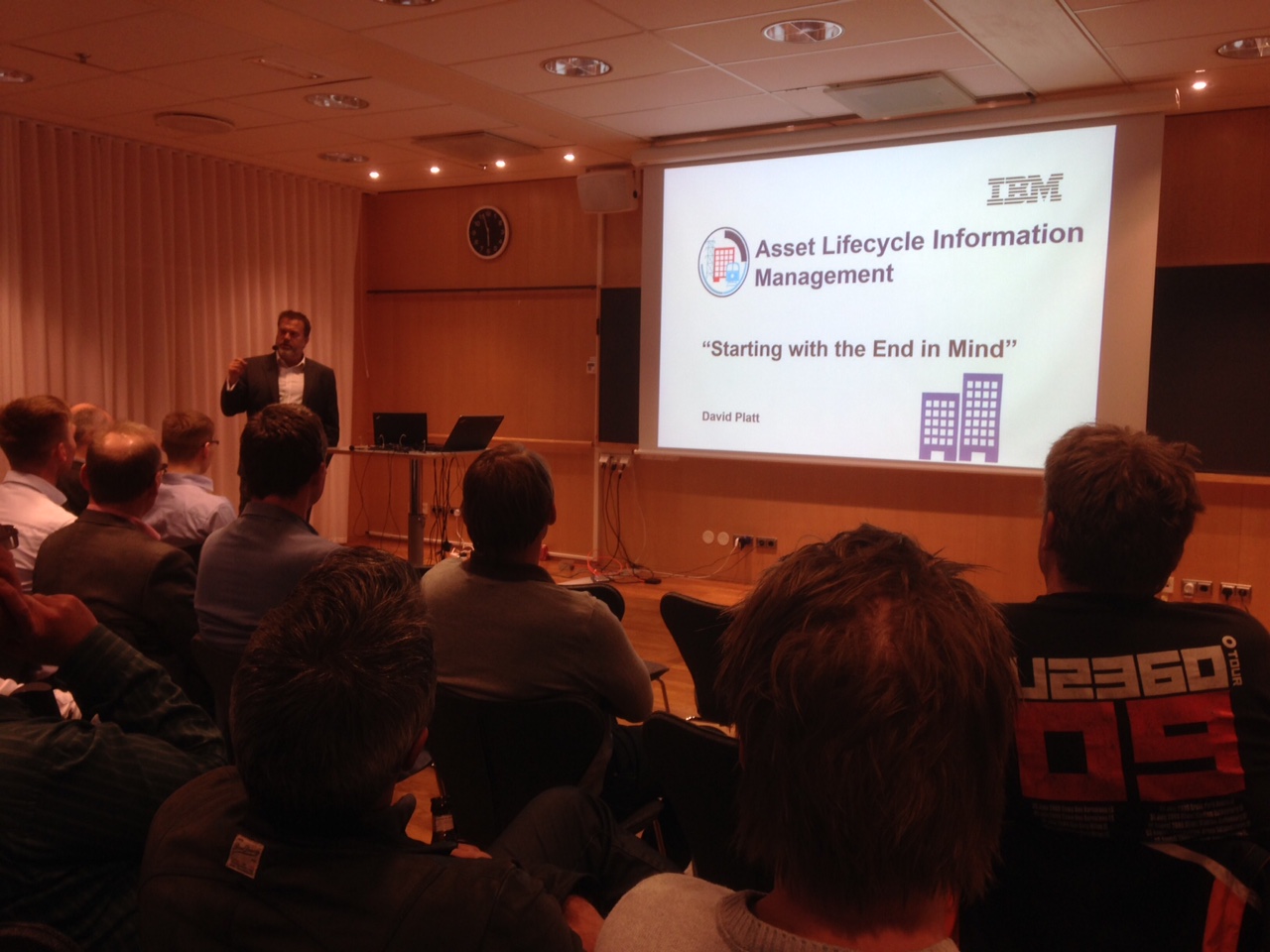
On 28th April, BIM lounge 2015 was held at the headquarters of Tyréns consulting firm in Stockholm where speakers from Sweden and U.K. shared their insights and experiences about the synergic effects envisioned by merging BIM as a Service (BaaS) and Internet of Things (IoT). Unfortunately, I missed the final presentations on the ubiquitous facility management system, IBM Maximo and the demonstration on the integrated use of IoT and BIM.

Ulrika Franke, CEO of Tyréns and president of BIM Alliance Sweden was the first speaker. She referred to the conservative nature of building industry and how this restrains efficiency and aggravates waste of resources. She then postulated that digitalizing is the central clue to improve automation in construction. This requires educating all actors across the AECO industry, new regulations and advanced business models, according to her.

Anders Fredholm, vice president of IBM Global Business Services clarified their initiative for encouraging a more efficient building information management. IBM promotes the notion of 'BIM as a service' (BaaS) implying that BIM is now an industry driver across the entire lifecycle of buildings from inception, through operation and maintenance and towards recycling and re-use of building materials. Fast and on-the-fly access to building information is increasingly becoming a business-enabler for construction firms. New contractual methods are gaining grounds for facilitating usecase-based payments. While actors in the automotive industry have now widely adopted Product Lifecycle Management (PLM) methods and Digital Mock-ups (DMUs) are prevalent in design of aircrafts and ships, the AECO industry is still lagging behind. Together with other public and private agents and within national programs such as RIBA Plan of Work in the UK, IBM aims to encourage actors to develop their skills and go digital.

The AECO industry is lagging behind others when it comes to automation (diagram is taken from my licentiate thesis
David Platt, industrial products lead at Digital Operations notified the surge in the number of organizations that see data as a resource. This is, in turn, triggered by the need for more lean performances as a business advantage over competent global competitors. Buildings are no more seen merely as buildings rather as dynamic material banks that should be used and re-used by building-owners efficiently. The key to a more functionally and environmentally efficient use and re-use of buildings and their embodied assets is constant measurement of building performance and tracing of building materials and assets. The seamless flow of information that is required for realizing this vision calls for soft-landing periods through handover of facilities and a shift of mentalities from silo thinking to collaborative thinking.

The moment technologies and working processes for a coordinated and steady flow and provision of building information are in place, predictive analyses for optimizing setups of assets and accurate KPI management in FM companies would be plausible.

¤¤¤¤¤¤

The final report of this post is about the intense and informative lecture by Jesse M. Keenan, adjunct professor at Columbia University and the director of the Center for Urban Real Estate (CURE). It was titled as "Recent Research in the Adaptation of the Built Environment" and held on 9th April at the Department of Urban Planning and Environment of KTH.

In an earlier post, I had reported on an earlier seminar focused on strategies for coastal resilience.  During that event, Hurricane Sandy was repeatedly referred to as one of the motivations and stimuli for aligning greater efforts for promoting resilience in urban and regional design and planning.

Hurricane Sandy was again mentioned by Keenan through his talk. Though, his remedy for hazards as such was a set of methodologies and concepts termed as 'adaptation' this time. According to the principals of adaptation as articulated by Keenan, natural hazards such as hurricanes, floods and tsunamis affect our built environment in such an extensive and devastating scale and in such diversified ways that confronting them urges for an overall shift in planning paradigms. While more focused solutions pronounced as the concept of 'resilience' mainly focus on maintaining the status quo though spatial provisions, adaptation is about handling massive transformations that could not be reversed. Adaptation is conceptualized at a more strategic level also incorporating top-level social and economic aspects of spatial decisions prior and during disasters. IT-features are essential for and central to adaption strategies.

A subtle point raised in Keenan's speech was the inherent conflict between adaptation and sustainability: sustainability in one system results in instability of other systems, while adaptation deals with the entire equilibrium as a whole. All in all, the concept of 'adaptation' suggests alluring prospects for confronting severe natural hazards of large magnitudes. Such holistic strategies for shaping and managing built environment should be constantly applied over long periods if the capacity for confronting destructive hazards is truly to be created ad maintained. A requisite for this is powerful and stable central decision-making institutions with legitimized top-down mandates. In the absence of such arrangements, more limited but focused and concrete solutions devised at the level of individual structures and urban level sound more plausible and beneficial.
Friday, March 27, 2015

Miscellaneous notes on recent events

23rd March
During the time I was communication officer at Stockholm's International Research Association (SIRAP), I got in contact with Stockholm's Academic Forum (Staf). In that regard, I was recently invited to Staf's inauguration of their new office at KTH main campus (Valhallavägen 79). This was a timely opportunity for meeting and talking to academicians from other universities around Stockholm. Staf's chairman, Moira von Wright, reported on recent developments including the initiatives for branding Stockholm as a world-class academic destination. She also announced that such efforts would thereafter be continued by the newly-born Stockholm Academic Network.

18th Mach
The workshop on BIM 360 Glue and Field was hosted by Cad-q. Joachim Dekker referred to the population increase in Stockholm as the driving force for a more accelerated construction pace. The increasing competition among current actors in the construction market and their international rivals calls for an increased use of more automated design and construction tools which are, at the time, concretized as BIM applications. BIM envisions an AECO industry with lower material and energy consumption, improved productivity and accelerated delivery. In the same fashion as previous decades since the emergence of the technology, BIM adoption level is the highest among architects and declines subsequently when it comes to engineers, contractors and owners; whereas it is the latter group who is assumed to benefit the most from BIM-implementation.

Pierre Gullander proceeded with a hands-on demonstration of Autodesk's BIM 360 products. The main objective of BIM 360 is to connect the design office to the construction site. BIM 360 Glue is intended for information exchange between the design and production units; whereas BIM 360 Field aims to coordinate the information from different production sources and sites and channel them into the hand-over documents.

BIM 360 Glue can interact with Navisworks and enables functionalities such as clash control, creating mark-ups, searching and filtering specific parameters and doing measurements in three-dimensional views. Using standard views instead of common navigation tools has proved to be easier on mouse-free tools such as tablets.

BIM 360 Field presumably facilitates tracking documents in combination with a model viewer, creating work orders and reports on issues on-the-fly during on-site inspection, assigning actor-specific tasks to work orders, automated management of inspection checklists, and monitoring overall status of the project and its progress rate. A number of early-adopters have already started using BIM 360 Field in their projects. Bravida is an example.

Rasmus Thomsen presented a brief demo of the under-development product of Autodesk, BIM 360 Layout. The idea is using a Total station for capturing the as-built model of an existing or under-construction structure and using the output for checking against the original design model and performing quality assurance and quality control procedures. However, the demo was focused on the point cloud capturing stage and did not include the comparison and QA/QC part. 

Andrew Bowles reported on the current state of implementation of BIM 360 Field in the UK. He referred to a project where using the application resulted in saving 9 hours of work per week compared with traditional methods. According to him, the implementation of the software also resulted in substantial reduction in claims from sub-contractors and other actors. This was realized by the ease of access to the required information in a consolidated and coordinated digital database. Site diaries, detailed reports and audit trail information are some examples of such types of information.

He also briefly presented projects where cloud-based information management facilitated direct transfer of building information from construction databases to the FM&O applications such as IBM Maximo. Such a cloud-based and file-import-and-export-free method is considered as the Autodesk's new paradigm for cross-disciplinary and cross-company information transfer. The vision is already realized for information transfer among Glue and Field applications. Yet, optimal work flows for benefiting such configurations and totally dismissing traditional building information registry and transfer methods need to be defined and widely implemented. 

Apparently, Autodesk is trying to add new functionalities to its software portfolio with the aim of providing a cradle-to-cradle package to design and construction firms. 

11th March
A breakfast seminar about Solibri Model-Checker for project managers was hosted by Graphisoft at their office in Solna (Sweden). Peter Dufvenberg, BIM-strategist at projektledarhuset, presented a number of cases of implementation of SMC in Stockholm. SMC is deployed for visualization, clash-control prior to and during periodical BIM coordination meetings and eventually minimizing the use of drawings. The models should, however, be visually checked before running SMC tools. In case of substantial losses of required information or inaccuracies, the model should be returned to the provider to be completed.

SMC has a specific plug-in for optimizing IFC files that are unnecessarily large. SMC also has now plug-ins for Swedish building codes such as different definitions of area calculation according to the Swedish standard, SS 21054-2009, i.e. BOA, BYA, BRA, BTA, etc. As common to all lectures on building information management, the potentials for benefiting BIM in the operations phase and relevant initiatives for this purpose such as the fi2xml format were also discussed.

4th March
In yet another lunch seminar at our department, Professor Hans Lind presented a critical view on the article 'A monstrous Hybrid’ which hypothesizes a shift from a regulated to a liberated Swedish housing market with the aim of relieving the housing shortages of the poor households. 

According to Prof. Lind, there has never happened such a phenomenon as a pure shift from a regulated to a liberated housing market. An evidence for this argument is that the rental prices in some suburbs of Stockholm such as Hanninge were market-driven already in 1970s. Apparently, forced rental reduction did by no means increase the poor household's access to the housing market in those suburbs.

In 1990, the government ceased to subsidize the interest rates for housing loans. Since then, the construction sector in Sweden has received no subsidy from the government at all; while no alternative governmental housing policy has been introduced either. This does not imply that current housing market is totally liberated; but that the real estate market policies have been left to municipalities rather than the market or the state. In such a situation, the decision-making power is distributed among local alliances - sometimes - with environmentalist agendas and the not-in-my-backyard groups and individuals. The result is often a stronger influence for those who try to reduce the costs of the municipalities.

A more concrete consequence of this trend is that the market has less influence on the pace, quality and quantity of construction; new actors can not survive in the market and established actors' strategic policies become the most influential force. The regional agents, who are expected to supervise municipalities, are quite often nominated and influenced by the municipalities themselves and are therefore neutralized. The excess of the supply of housing which adds to the bargaining power of the poor, is not realized under such circumstances.

27th February
It was May 2013 during the 19th CIB World Building Congress in Brisbane when, for the first time, I noticed that the increasingly popular concept of sustainability had been overshadowed by the notion of 'resilience' presumably in the aftermath of Hurricane Sandy and its devastating consequences for the U.S. cities.

The Coastal Resilience Seminar was organized jointly by KTH Center for a Sustainable Built Environment and City of Stockholm. Gunnar Söderholm, the head of Environment and Health Administration in the City of Stockholm, opened the session with addressing some interesting facts about Stockholm: the city was designated as the first green capital in Europe in 2010; Stockholm is growing at an accelerating pace; according to Vision 2030, by 2020, Stockholm will accommodate 250'000 new residents, will possess 140'000 new dwellings and will become a notably denser city. A sustainable urban growth will therefore gain even more importance.

Map of flooding risk in central Stockholm
The carbon dioxide equivalent emissions of the city per capita in 2015 has been estimated as 3,0 tonnes. This demonstrates a forty percent reduction since 1990. According to the vision document, Stockholm will be a fossil-fuel free city by 2040. While the requirements of ecological sustainability are not far from being met, global warming keeps to be a constant threat to the city in the meanwhile. Like many other metropolitan areas around the world, Stockholm too is now exposed to the risk of flooding. While the Hammarby Waterfront and the Royal Seaport projects were primarily marketed as sustainable urban planning initiatives, the reconstruction of Slussen has a strong focus on handling the consequences of the sea level rise. The municipality is nowadays concerned the most with the question of how to make a dense - and presumably sustainable - city also resilient.

Green islands
The next speaker was Guy Nordenson, Professor of architecture and structural engineering at Princton University. He presented a number of design alternatives for coastal resilience and climate adoption. Examples were taken from New York, Palisade Bay and Yangtze River Delta Project.

According to him, merely controlling the coastal lines using heavy engineering fortifications such as the ones erected in Saint Petersburg and Dutch cities is no more considered as a viable solution for flooding. A more plausible solution is confronting waves and hurricanes at three different zones: on the edge, inland and on the water. Constructing soft edges and allowing the water come in and managing it
inland has now gained a wider acceptance. In this approach, public spaces, landscape features, elevated roads, canals, green areas, raised houses, amphibious suburbs and areas of refuge located in high places are integrated components of an overall strategic plan for flood management. Different arrangements of elements as such are combined to serve different scenarios for hurricanes and the see level rise and the consequences are studied with the aim of identifying the best holistic design alternatives.


New Slussen: the Water Plaza
Monica Granberg, the executive director at the City of Stockholm, was the next speaker who talked about the project of reconstruction of SlussenSince inauguration of the first lock, the Queen Kristina's lock, in 1642, Slussen has been reconstructed app. every 100 years: the Christopher Polhelm's lock was built in 1755 which was replaced by the Nils Ericson's lock in 1850. The latter was in place until 1935 when the current lock, Slussen, was constructed. Existing facilities and infrastructure at Slussen are in a very bad technical condition now. Improving the structural and spatial qualities of the area is, however, not the only objective of the project.

There are many facilities, cultural sites and agricultural farms located around lake Mälaren. Flooding could therefore cause drastic consequences for more than two million people such as pollution of drinking water and economical losses. The new Slussen is designed to cope with the worst case scenario of the see level rise - which is estimated as one meter by 2100. The locks between the lake Mälaren and the Baltic Sea in the new design will increase the drainage capacity of lake Mälaren up to five times the current facilities and reduce the risk of flooding.

As the final speech of the seminar, Zahra Kalantari, the functional manager at ÅF presented some general facts about Stockholm's by-pass project, the East Link project for high-speed rail lines and the 'Blue Green Solution' initiative. The seminar was rounded up by a panel discussion moderated by Gunnar Söderholm.

Monday, May 20, 2013

World Building Congress 2013

During my thirty-hour rail trip from Brisbane to Cairns, I came across more roof solar panels than any other local Australian feature. I would now prefer to associate this country first and foremost with its vibrant social atmosphere, good wine, good food, sunny days, and welcoming, friendly, and easygoing people rather than kangaroos and koalas! Yet, those exotic ibises with their iconic long curved beaks freely wandering around the city were reminders of the unique flora and fauna of the continent.  

The alluring city of Brisbane hosted this year’s World Building Congress. The event was somehow overshadowed and influenced by recent natural disasters around the world, namely floods in Queensland and New York City and earthquakes as well as the financial crisis. The most concurrent topics among the works presented were resilience, sustainability, safety and security, offsite manufacturing, integrated design and planning, and smart building knowledge management. More or less similar topics have been introduced and discussed in the first series of CIB Research Roadmaps

The major theme of the congress, construction and society, was brought up, emphasized, and clarified in concrete terms by the Minister for Housing and Public Works of the Queensland Government, Tim Mander. The eventual goal is to add value to buildings through – among all - innovation, PPP constructs, and whole-life cost analysis, according to him. 

The first keynote speaker, Prof. Martin Fischer from Stanford University communicated their most recent findings on how to simulate numerous possibilities of a construction project before actual construction. The answer to the question “why we come up short in projects?”, in his opinion, can be traced back to organization and prediction. Here comes a list on some other topics Professor Fischer touched on in his talk: the importance of the stage following the design phase and prior to construction, clear-cut clarification of the goals of the project, elimination of uncertainties, on-budget, on-schedule, and quality projects, staff working for the project rather than for the company, continual evaluation and redefinition of the process, manufacturing building elements based on digital models, deployment of laser scanning for post-construction determination of discrepancies, implementing Multidisciplinary Design Optimization method (MDO) for balancing carbon footprint against life cycle costs, using Space Constraint Method (SCM) for evaluating efficiency of use of construction space, and integrating subcontractors in the design team. 

During the afternoon keynote speech of the first day of the congress, Peter Verwer, head of the Property Council of Australia expressed an enthusiastic appraisal of the cities and their pioneering role in our modern societies. Urbanized and connected living areas nurture productivity, he asserted. Urbanization, IT, and globalization are three major contemporary driving forces that should be benefited for creating flourishing and evolving cities, he believed. Nonetheless, bringing the language of technology and that of business closer to each other is an essential requirement for more efficient urban services. 

Later on, during the panel discussion of the first day of the congress, a number of global challenges ahead of the building industry were put forward: 
  • Still 30% of construction work is done onsite (on average). 
  • Building Information Modeling is quite often comprehended as a technology that customers are reluctant to use. 
  • Basic requirements and strategic guidelines for creating economic shelters and modernized settlements seem to diverge extensively. 
  • Costs of building are increasing because of the higher costs of the newer technologies. This poses a serious threat to small construction firms. In the Netherlands, for example, 60% of the construction firms of today will vanish away by 2050 
  • Costs of operating and maintaining public welfare equipment will double by 2040 due to increasing costs of technologies. 
  • Green buildings should be replaced by resilient buildings. 

During the second day’s panel discussion, Carol Le Gall, chief executive director of the Centre Scientifique et Technique du Bâtiment (CSTB) notified contemporary challenges in the building industry with regard to optimization of production and consumption of energy, carbon, water, and waste. She continued with a comprehensive report on CSTB’s project for analyzing real-time indoor air quality; LUM’AIR. Prof. Peter Barrett from the University of Salford concluded the session with an inspiring talk to remind a neglected matter of course: what the overall role of the entire building industry is. Research activities in the field, in his opinion, may follow educational, economic, social, or environmental concerns; but they should eventually have a holistic impact and relate to how the buildings affect people. At the same time as agents in the FM sector neglect the impacts of their possessions on the lives of the mankind and simply regard their profession as a business similar to any other profitable affair, our built environment either contributes to health hazards such as Alzheimer, anxiety, and vision problems, or nurtures healthy and thriving societies. Finally, Lyn Beazley shed some light on recent technological achievements realized in the far western Australian port of Perth and Curtain University. The initiative for transforming non-visible parts of the light into energy by using photovoltaic cells and nanotechnology is an outstanding example of their cutting-edge research projects. 

The afternoon keynote speaker of the second day, Brian Krause from Turner BIM gave a ravishing lecture on their most recent developments in the field of BIM technology seasoned with demonstrations of a software solution for BIM-enabled facility management and operations developed at the University of Columbia. He touched on a variety of topics and issues in the field of use of IT for construction including authoring BIM execution plans, evaluation of total cost of ownership (TCO), turning SketchUp into an object-based modeling tool by means of plug-ins, pushing legislative boundaries forward by submitting a 3D safety model to NYC municipality, optimizing clash detection functions of existing applications, use of barcodes for more automated maintenance routines, and promoting lean BIM processes. 

The third day’s keynote speakers, Dr. Wim Bakens and Dr. Shyam Sunder depicted, among all, the CIB’s general research roadmap. Dr. Wim Bakens clarified the necessity of a research roadmap as a glossary of agreed-upon definitions and an overall conceptual model. Contemporary construction research institutes, namely CSIRO, VTT, TNO, bre, and CSTB need to be able to demonstrate that their concerns are relevant, they have access to all members of the community, and are capable of efficient and effective knowledge exchange and  collaboration. Implementation of research in practice is also momentous which calls for a closer contact with the society, industry, and government. He then noticed the fact that there is a tipping point for the percentage of investment in construction out of GNP to secure a positive contribution to development of the society. This could be termed as the built environment’s caring capacity; a concept that is closely intertwined with decline of building and the optimal peak of new construction. He articulated his proposed remedy as, among all, implementing different types of business models for overcoming the declining market, more efficient risk management, and future-oriented, sustainable, resilient, affordable, and adaptive buildings... I will probably provide a summary of other contributions in a separate post later on. 

David Mitchell, Christoph Merschbrock, Eilif Hjelseth, and me got together in a bar in Brisbane's South Bank before the last night congress dinner