
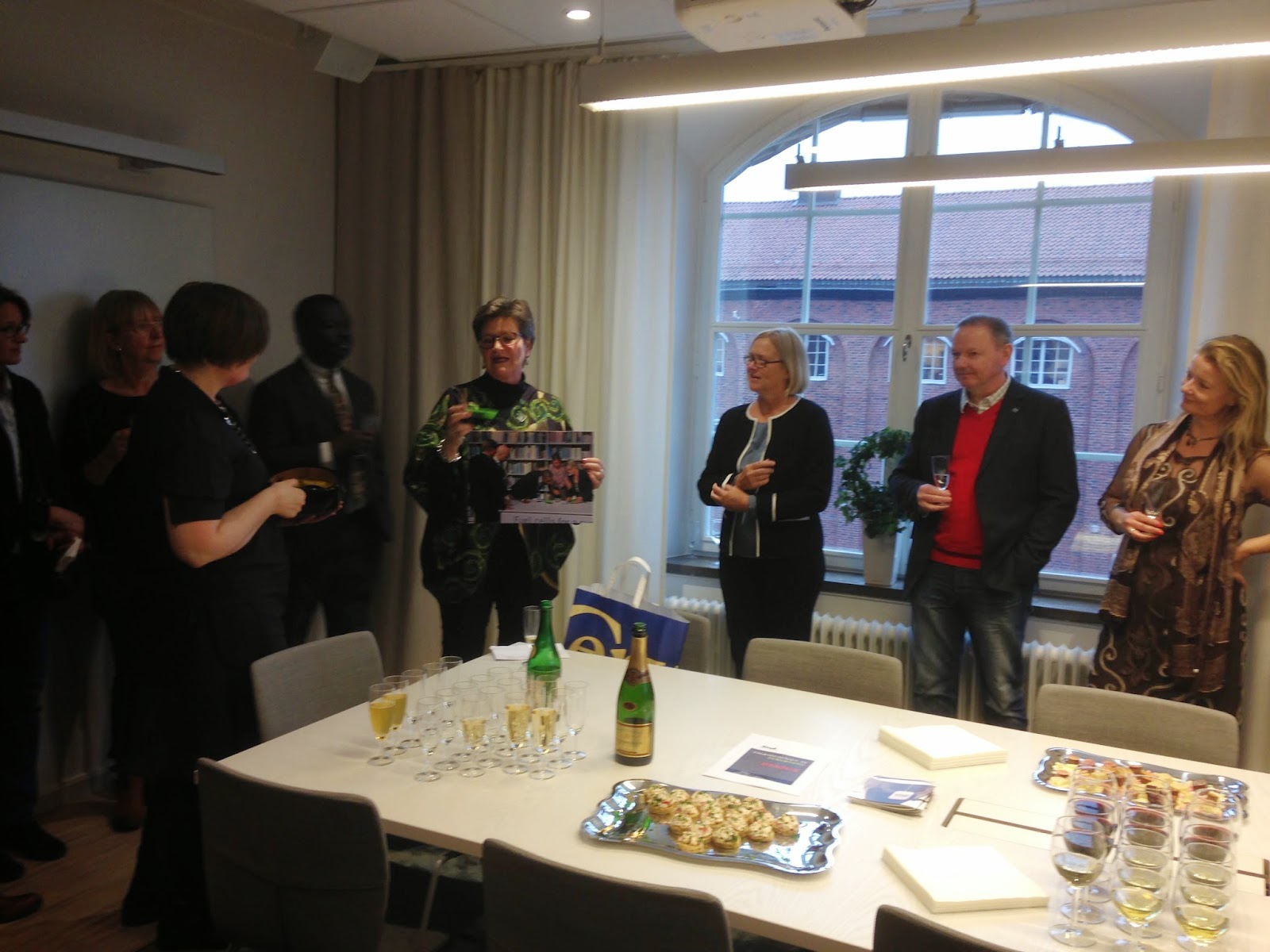
 During the time I was communication officer at Stockholm's International Research Association (SIRAP), I got in contact with Stockholm's Academic Forum (Staf). In that regard, I was recently invited to Staf's inauguration of their new office at KTH main campus (Valhallavägen 79). This was a timely opportunity for meeting and talking to academicians from other universities around Stockholm. Staf's chairman, Moira von Wright, reported on recent developments including the initiatives for branding Stockholm as a world-class academic destination. She also announced that such efforts would thereafter be continued by the newly-born Stockholm Academic Network.
18th Mach
 The workshop on BIM 360 Glue and Field was hosted by Cad-q. Joachim Dekker referred to the population increase in Stockholm as the driving force for a more accelerated construction pace. The increasing competition among current actors in the construction market and their international rivals calls for an increased use of more automated design and construction tools which are, at the time, concretized as BIM applications. BIM envisions an AECO industry with lower material and energy consumption, improved productivity and accelerated delivery. In the same fashion as previous decades since the emergence of the technology, BIM adoption level is the highest among architects and declines subsequently when it comes to engineers, contractors and owners; whereas it is the latter group who is assumed to benefit the most from BIM-implementation.
Pierre Gullander proceeded with a hands-on demonstration of Autodesk's BIM 360 products. The main objective of BIM 360 is to connect the design office to the construction site. BIM 360 Glue is intended for information exchange between the design and production units; whereas BIM 360 Field aims to coordinate the information from different production sources and sites and channel them into the hand-over documents.
BIM 360 Glue can interact with Navisworks and enables functionalities such as clash control, creating mark-ups, searching and filtering specific parameters and doing measurements in three-dimensional views. Using standard views instead of common navigation tools has proved to be easier on mouse-free tools such as tablets.
BIM 360 Field presumably facilitates tracking documents in combination with a model viewer, creating work orders and reports on issues on-the-fly during on-site inspection, assigning actor-specific tasks to work orders, automated management of inspection checklists, and monitoring overall status of the project and its progress rate. A number of early-adopters have already started using BIM 360 Field in their projects. Bravida is an example.
Rasmus Thomsen presented a brief demo of the under-development product of Autodesk, BIM 360 Layout. The idea is using a Total station for capturing the as-built model of an existing or under-construction structure and using the output for checking against the original design model and performing quality assurance and quality control procedures. However, the demo was focused on the point cloud capturing stage and did not include the comparison and QA/QC part.
Andrew Bowles reported on the current state of implementation of BIM 360 Field in the UK. He referred to a project where using the application resulted in saving 9 hours of work per week compared with traditional methods. According to him, the implementation of the software also resulted in substantial reduction in claims from sub-contractors and other actors. This was realized by the ease of access to the required information in a consolidated and coordinated digital database. Site diaries, detailed reports and audit trail information are some examples of such types of information.
He also briefly presented projects where cloud-based information management facilitated direct transfer of building information from construction databases to the FM&O applications such as IBM Maximo. Such a cloud-based and file-import-and-export-free method is considered as the Autodesk's new paradigm for cross-disciplinary and cross-company information transfer. The vision is already realized for information transfer among Glue and Field applications. Yet, optimal work flows for benefiting such configurations and totally dismissing traditional building information registry and transfer methods need to be defined and widely implemented.
Apparently, Autodesk is trying to add new functionalities to its software portfolio with the aim of providing a cradle-to-cradle package to design and construction firms.
11th March

A breakfast seminar about Solibri Model-Checker for project managers was hosted by Graphisoft at their office in Solna (Sweden). Peter Dufvenberg, BIM-strategist at projektledarhuset, presented a number of cases of implementation of SMC in Stockholm. SMC is deployed for visualization, clash-control prior to and during periodical BIM coordination meetings and eventually minimizing the use of drawings. The models should, however, be visually checked before running SMC tools. In case of substantial losses of required information or inaccuracies, the model should be returned to the provider to be completed.
SMC has a specific plug-in for optimizing IFC files that are unnecessarily large. SMC also has now plug-ins for Swedish building codes such as different definitions of area calculation according to the Swedish standard, SS 21054-2009, i.e. BOA, BYA, BRA, BTA, etc. As common to all lectures on building information management, the potentials for benefiting BIM in the operations phase and relevant initiatives for this purpose such as the fi2xml format were also discussed.
4th March
In yet another lunch seminar at our department, Professor Hans Lind presented a critical view on the article 'A monstrous Hybrid’ which hypothesizes a shift from a regulated to a liberated Swedish housing market with the aim of relieving the housing shortages of the poor households.
In yet another lunch seminar at our department, Professor Hans Lind presented a critical view on the article 'A monstrous Hybrid’ which hypothesizes a shift from a regulated to a liberated Swedish housing market with the aim of relieving the housing shortages of the poor households.
According to Prof. Lind, there has never happened such a phenomenon as a pure shift from a regulated to a liberated housing market. An evidence for this argument is that the rental prices in some suburbs of Stockholm such as Hanninge were market-driven already in 1970s. Apparently, forced rental reduction did by no means increase the poor household's access to the housing market in those suburbs.
In 1990, the government ceased to subsidize the interest rates for housing loans. Since then, the construction sector in Sweden has received no subsidy from the government at all; while no alternative governmental housing policy has been introduced either. This does not imply that current housing market is totally liberated; but that the real estate market policies have been left to municipalities rather than the market or the state. In such a situation, the decision-making power is distributed among local alliances - sometimes - with environmentalist agendas and the not-in-my-backyard groups and individuals. The result is often a stronger influence for those who try to reduce the costs of the municipalities.
A more concrete consequence of this trend is that the market has less influence on the pace, quality and quantity of construction; new actors can not survive in the market and established actors' strategic policies become the most influential force. The regional agents, who are expected to supervise municipalities, are quite often nominated and influenced by the municipalities themselves and are therefore neutralized. The excess of the supply of housing which adds to the bargaining power of the poor, is not realized under such circumstances.
27th February
It was May 2013 during the 19th CIB World Building Congress in Brisbane when, for the first time, I noticed that the increasingly popular concept of sustainability had been overshadowed by the notion of 'resilience' presumably in the aftermath of Hurricane Sandy and its devastating consequences for the U.S. cities.
The Coastal Resilience Seminar was organized jointly by KTH Center for a Sustainable Built Environment and City of Stockholm. Gunnar Söderholm, the head of Environment and Health Administration in the City of Stockholm, opened the session with addressing some interesting facts about Stockholm: the city was designated as the first green capital in Europe in 2010; Stockholm is growing at an accelerating pace; according to Vision 2030, by 2020, Stockholm will accommodate 250'000 new residents, will possess 140'000 new dwellings and will become a notably denser city. A sustainable urban growth will therefore gain even more importance.
The carbon dioxide equivalent emissions of the city per capita in 2015 has been estimated as 3,0 tonnes. This demonstrates a forty percent reduction since 1990. According to the vision document, Stockholm will be a fossil-fuel free city by 2040. While the requirements of ecological sustainability are not far from being met, global warming keeps to be a constant threat to the city in the meanwhile. Like many other metropolitan areas around the world, Stockholm too is now exposed to the risk of flooding. While the Hammarby Waterfront and the Royal Seaport projects were primarily marketed as sustainable urban planning initiatives, the reconstruction of Slussen has a strong focus on handling the consequences of the sea level rise. The municipality is nowadays concerned the most with the question of how to make a dense - and presumably sustainable - city also resilient.
The next speaker was Guy Nordenson, Professor of architecture and structural engineering at Princton University. He presented a number of design alternatives for coastal resilience and climate adoption. Examples were taken from New York, Palisade Bay and Yangtze River Delta Project.
According to him, merely controlling the coastal lines using heavy engineering fortifications such as the ones erected in Saint Petersburg and Dutch cities is no more considered as a viable solution for flooding. A more plausible solution is confronting waves and hurricanes at three different zones: on the edge, inland and on the water. Constructing soft edges and allowing the water come in and managing it
inland has now gained a wider acceptance. In this approach, public spaces, landscape features, elevated roads, canals, green areas, raised houses, amphibious suburbs and areas of refuge located in high places are integrated components of an overall strategic plan for flood management. Different arrangements of elements as such are combined to serve different scenarios for hurricanes and the see level rise and the consequences are studied with the aim of identifying the best holistic design alternatives.
Monica Granberg, the executive director at the City of
Stockholm, was the next speaker who talked about the project of reconstruction of Slussen. Since inauguration of the first lock, the Queen Kristina's lock, in 1642, Slussen has been reconstructed app. every 100 years: the Christopher Polhelm's lock was built in 1755 which was replaced by the Nils Ericson's lock in 1850. The latter was in place until 1935 when the current lock, Slussen, was constructed. Existing facilities and infrastructure at Slussen are in a very bad technical condition now. Improving the structural and spatial qualities of the area is, however, not the only objective of the project.
There are many facilities, cultural sites and agricultural farms located around lake Mälaren. Flooding could therefore cause drastic consequences for more than two million people such as pollution of drinking water and economical losses. The new Slussen is designed to cope with the worst case scenario of the see level rise - which is estimated as one meter by 2100. The locks between the lake Mälaren and the Baltic Sea in the new design will increase the drainage capacity of lake Mälaren up to five times the current facilities and reduce the risk of flooding.
The Coastal Resilience Seminar was organized jointly by KTH Center for a Sustainable Built Environment and City of Stockholm. Gunnar Söderholm, the head of Environment and Health Administration in the City of Stockholm, opened the session with addressing some interesting facts about Stockholm: the city was designated as the first green capital in Europe in 2010; Stockholm is growing at an accelerating pace; according to Vision 2030, by 2020, Stockholm will accommodate 250'000 new residents, will possess 140'000 new dwellings and will become a notably denser city. A sustainable urban growth will therefore gain even more importance.
 |
| Map of flooding risk in central Stockholm |
 |
| Green islands |
According to him, merely controlling the coastal lines using heavy engineering fortifications such as the ones erected in Saint Petersburg and Dutch cities is no more considered as a viable solution for flooding. A more plausible solution is confronting waves and hurricanes at three different zones: on the edge, inland and on the water. Constructing soft edges and allowing the water come in and managing it
inland has now gained a wider acceptance. In this approach, public spaces, landscape features, elevated roads, canals, green areas, raised houses, amphibious suburbs and areas of refuge located in high places are integrated components of an overall strategic plan for flood management. Different arrangements of elements as such are combined to serve different scenarios for hurricanes and the see level rise and the consequences are studied with the aim of identifying the best holistic design alternatives.
 |
| New Slussen: the Water Plaza |
There are many facilities, cultural sites and agricultural farms located around lake Mälaren. Flooding could therefore cause drastic consequences for more than two million people such as pollution of drinking water and economical losses. The new Slussen is designed to cope with the worst case scenario of the see level rise - which is estimated as one meter by 2100. The locks between the lake Mälaren and the Baltic Sea in the new design will increase the drainage capacity of lake Mälaren up to five times the current facilities and reduce the risk of flooding.
As the final speech of the seminar, Zahra Kalantari, the functional manager at ÅF presented some general facts about Stockholm's by-pass project, the East Link project for high-speed rail lines and the 'Blue Green Solution' initiative. The seminar was rounded up by a panel discussion moderated by Gunnar Söderholm.


